
Banking turmoil adds new headwinds to construction industry
Industry insiders point out that rising interest rates and banking turmoil are driving up construction financing costs, leading to project delays or cutbacks, with construction activity expected to slow in the coming months.
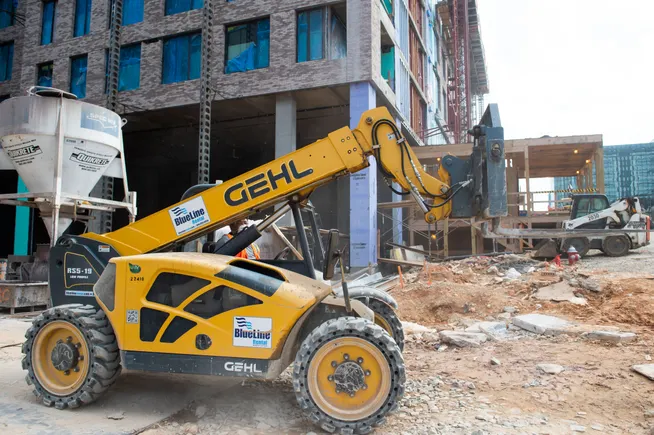
Multiple sources told Construction Dive that construction activity is expected to show signs of slowing in the coming months, as financing costs for many developers have become prohibitively high.
For example, rising interest rates have made construction projects riskier and profit margins narrower, said Nicolas McNamara, director of project management at CBRE, a Dallas-based commercial real estate services firm.

"Rising financing costs remain a major concern in the construction sector," McNamara said. "Developers are facing the challenge of projects not being able to achieve profitability due to higher interest rates."
He added that recentbanking sector uncertaintyhas exacerbated the problems facing construction firms.
The impact of these headwinds is already visible. According to data from the Associated Builders and Contractors, constructionbacklog fell to 8.7 months in March, the lowest level since August 2022.
Meanwhile, the Dodge Momentum Index, which measures nonresidential building planning, fell 8.6% in March,down 8.6%, which Sarah Martin, associate director of forecasting at Dodge, attributed to banking sector insecurity.
"As banking sector insecurity intensifies, lending standards, especially at smaller banks, have tightened significantly," Martin said. "Therefore, owners and developers are more likely to hold back in the short term."
Todd Burns, president of project and development services at JLL, a Chicago-based real estate services firm, said this uncertainty will lead large banks to be cautious in lending or to mitigate risk by raising interest rates. These large banks, such as JPMorgan Chase, Citigroup, and Morgan Stanley, often dominate the pricing of capital costs.

"Rising interest rates and higher capital costs will continue to negatively impact financing," Burns said. "If capital costs are high, financing costs will obviously be high as well."
This trend has heightened overall concerns about access to capital and could create a vicious cycle: lenders raise interest rates to limit risk, while developers are unwilling or unable to pay higher rates to achieve target returns. McNamara said the result could be a recession that has been discussed for a long time.
"Banks do face asset issues, such as exposure to unhedged government securities and the risk of declining real estate values," McNamara said. "The current situation could lead to tighter credit conditions and possibly a mild recession in the second half of 2023."
Focus on yields
McNamara said another factor affecting financing availability is the focus on yields. Due to changes in the financing environment, developers now need to achieve higher unlevered cost yields—that is, the return on a property after purchase costs and renovation expenses—to move projects forward.
He added that this poses challenges for new projects to meet financial targets and could lead to fewer approved projects. McNamara expects "projects will be canceled outright, or significantly phased or scaled back, in order to secure financing."
Meanwhile, Burns said owners and developers are showing a willingness to wait out interest rate volatility, which further slows project starts. In the current environment, even projects that can achieve profitability often require extensive due diligence.
This delay ultimately leads to increased costs, McNamara said.
"If a project can be profitable, it is only after a significant amount of time and preparation," McNamara said. "Then additional budget is needed to cope with rising construction costs."
For example, Bill Shopoff, president and CEO of Shopoff Realty Investments, said in an email to Construction Dive that due to construction financing issues, the company haspaused construction of the Dream Resort project in Las Vegas, a project costing approximately $550 million.
High interest rates and unfavorable capital markets have also prompted Vornado todelay its Pennsylvania Station projectby another two to three years, said Michael Franco, the company's president and CFO, on its most recent earnings call in February.
"Capital markets now make new construction projects almost impossible," Franco said.
Long lead times
Since the outbreak of the COVID-19 pandemic, excessively long material lead times have exacerbated these lending challenges.
"Longer lead times increase carrying costs for contractors and developers," Burns said.
Richard Kennedy, president and CEO of Skanska USA, said lead times remain at "unprecedented levels," especially for criticalelectromechanical equipment. According to theCBRE first-quarter market trends report, although supply of some materials has improved, the overall supply chain remains fragile.
For example, Harrington Industrial Plastics, a supplier based in Chino, California, reported supply issues across all materials, according to a recent report by XL Construction. Meanwhile, Ryan Herco Flow Solutions, a supplier based in Burbank, California, recently ran out of a type of piping, causing additional delays, the report said.
This in turn further pushes up actual capital costs.
Long lead times remain a challenge for contractors
| Material | Estimated lead time |
|---|---|
| Polypropylene pipe | 12 months |
| Electromechanical equipment | 16-35 weeks |
| Prefabricated structural steel | 20-24 weeks |
| Metal joists | 18-24 weeks |
| Plumbing fixtures | 16-20 weeks |
| Gypsum board | 4-16 weeks |
| Concrete | 10 weeks |
| Rebar | 8 weeks |
| Steel pipe | 6-8 weeks |
| Insulation | 4 weeks |
| Lumber | 2 weeks |
Source: XL Construction
"These costs must be borne by the financing side," Burns said. "This could lead banks to continue charging high rates on cash, thereby prolonging economic headwinds."
Nevertheless, McNamara said the Federal Reserve's liquidity support during the collapse of Silicon Valley Bank and Signature Bank, as well as the implicit guarantee of uninsured deposits at other banks, may begin to stabilize the situation. The International Monetary Fund also said on April 11 that last month's bank failures could lead to a credit crunch, which wouldreinforce central banks' efforts to curb price pressures。
Additionally, many observers believe the bank failures could ultimately force the Fed to pause its rate hikes. In March, the Fedraised rates by 25 basis points, but signaled that hikes may be nearing an end.
McNamara added that the industry may not face a crisis like 2008, but he acknowledged "it is too early to tell." This is because, despite the significant impact of U.S. regional bank failures, international contagion remains limited.
"The silver lining is that this could help the Fed curb the active private sector and fight inflation. Rate hikes can still be expected, but mild rate cuts could begin in the fourth quarter," McNamara said. "Given stronger consumer and corporate balance sheets, no major construction boom, and a healthier international economy than in 2008, a mild recession is more likely than a hard landing."