
Summer Campus Construction Wave: Federal Funds Drive Facility Upgrades Across U.S. School Districts
Shiwi Ts'ana Elementary School in Zuni, New Mexico, plans to begin construction on a $1.2 million outdoor learning space this summer, reflecting a broader trend of school districts nationwide using federal pandemic relief funds for facility upgrades. Although funds were approved in 2020-2021, project planning and execution have taken considerable time and face obstacles such as supply chain and labor shortages. The obligation deadline for ESSER III funds is September 30, 2024, and the expenditure deadline is January 28, 2025, prompting districts to accelerate their projects.
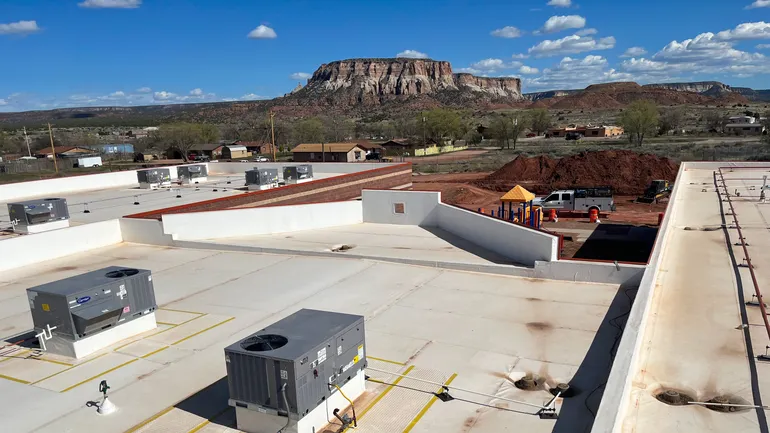
Outside the Shiwi Ts'ana Elementary School in Zuni, New Mexico, stand flat-topped mesas that glow gold as the sun sets. This spectacular view will be shared by more students and staff once an outdoor learning space is completed late this summer.
"We're in a high desert area, but we have a lot of beauty," said Martin Romine, finance director of Zuni Public School District. "We want to get students outside and connected to nature."
The $1.2 million project will build Wi-Fi-equipped terraced seating next to the school playground, making it easy for students to transition between recess and class. Romine said construction will begin immediately after the school year ends and is expected to be completed before the fall semester.
Like Shiwi Ts'ana Elementary, schools across the country anticipate a wave of federally funded facility upgrades this summer. The timing coincides with the gradual release of a backlog of projects, and with fewer students and staff on campus during summer break, construction is logistically more convenient.
Although Congress approved pandemic Elementary and Secondary School Emergency Relief (ESSER) funds in 2020 and 2021, planning and executing construction projects still takes months or even years. Supply chain issues and labor shortages pose additional challenges for districts, which must use funds by federal deadlines under different rules for the three ESSER allocations. The largest, ESSER III, totals $121.9 billion, with an obligation deadline of September 30, 2024, and an expenditure deadline of January 28, 2025.
"We want to change how kids view school and increase their excitement about attending, because we're doing things we've never done before."
— Martin Romine, Finance Director, Zuni Public School District
In Zuni, the district also plans to start construction this summer on a $1.3 million middle school outdoor learning area, including a pond that collects rainwater and elevated teaching platforms. Romine said it will be a pleasant space for classes, lunch, and after-school activities.
"This funding has been very beneficial, allowing us to complete projects we never considered before the money arrived," Romine said. "We want to change how kids view school and increase their excitement about attending, because we're doing things we've never done before."
Pre-pandemic construction needs
Schools nationwide are allocating a portion of COVID-19 recovery funds to improve facilities, including replacing windows and doors, upgrading heating and cooling systems, installing new roofs, modernizing classroom lighting, and enhancing security.
According to data services company Burbio, of about 6,500 districts, 23.9% of ESSER III spending plans (involving about $92 billion) allocate funds to facilities and operations. Among these, repairing or replacing HVAC systems and ventilation equipment is the most common project, followed by facility improvements to prevent disease, based on Burbio's research through March.
Healthy air circulation became a priority for facility projects as schools sought to reduce COVID transmission and attract students and staff back to campus after months of remote learning. But in fact, many school administrators knew their HVAC systems needed replacement or repair long before the pandemic. According to a 2020 report from the U.S. Government Accountability Office, an estimated 41% of districts needed to update or replace HVAC systems in at least half of their schools, affecting about 36,000 schools nationwide.
Many school and district leaders say there has never been such a large-scale need for facility improvements coinciding with an unprecedented influx of flexible federal funding.
"I would say the extra funding has been fantastic for our district," said Trisha Schock, executive director of administrative services at North Central ESD 171 in Wenatchee, Washington. The agency provides education-related services to 29 public school districts, as well as a tribal school, a charter school, and several private schools.
Schock said that in addition to capital improvement funds, ESSER funding supported staff increases, academic interventions, social-emotional outreach, curriculum enhancements, student meals, and more. "Being able to purchase so many positive things," Schock said.
In Dearborn, Michigan, the school system will continue adding air conditioning to eight—and possibly nine—schools this summer. Construction has already begun, with workers installing ductwork classroom by classroom while students are temporarily relocated to other spaces in the building. The district hopes to complete most of the work over the summer through phased planning, according to its website.
 Snow Elementary School in Dearborn Public Schools, Michigan, is upgrading its HVAC system, including adding air conditioning. ESSER-supported projects include adding air conditioning to eight—and possibly nine—schools.
Only about a third of the district's schools have air conditioning. The ESSER-supported projects mark the district's first large-scale effort to add air conditioning to older buildings. After a November 2019 bond proposal to upgrade schools failed by a few hundred votes, ESSER allowed the district to move forward with some projects, said David Mustonen, communications and marketing director for Dearborn Public Schools.
A 2022 study by the Association of School Business Officials International (ASBO) on ESSER spending practices highlighted administrators' expectations that building improvements would make schools safer and provide better facilities for active learning and student engagement. "Our old buildings got repaired, HVAC units were replaced, and all schools also switched to LED lighting to provide the best possible learning environment," one Louisiana district administrator told ASBO.
Construction obstacles
However, in many places, the enthusiasm and optimism of school communities about using billions in federal funds to improve infrastructure have been dampened by practical difficulties. Pandemic-related supply chain issues have caused delays in equipment and materials, extending construction timelines. For example, various HVAC, window, door, and roof replacement projects have been delayed by 10 to 15 months, said Elleka Yost, advocacy director at ASBO.
"Unexpected delays caused by supply chain issues and labor shortages in the construction industry are a major concern for districts seeking to use funds for such purposes," Yost said.
Washington state's Warden School District began an HVAC and chiller replacement project in February 2022, originally scheduled for completion in August 2022. But as of early April, neither was finished. According to information Schock obtained from the district, the contractor faced multiple delays on equipment and experienced staffing shortages.
In the Zuni district, which has 1,100 students, Romine worries about the progress of another ESSER-funded project. A pool building that has been closed for 12 years is slated to receive new HVAC and dehumidifier units. He said that while the pool and diving boards are in good condition, the facility cannot be used without proper air and ventilation systems. Many in this rural community hope the $1 million project will be completed, as it would become the only pool for local residents and students once finished.
"This one worries me now, because if the drawings take six months, we'll face a very tight deadline to get all the equipment shipped and installed before the funds expire," Romine said.
Another ESSER contract to replace the chiller at Zuni High School was signed in January 2022, but is currently only 85% complete, with the contractor waiting for needed parts, Romine said. Another project to replace the HVAC at Twin Buttes Cyber Academy—funded with $1.7 million in federal recovery funds—was completed last fall. Romine said the district had planned this upgrade before the pandemic, so it was able to start quickly when ESSER funds were allocated.
"Unexpected delays caused by supply chain issues and labor shortages in the construction industry are a major concern for districts seeking to use funds for such purposes."
— Elleka Yost, Advocacy Director, Association of School Business Officials International
In addition to project delays, inflation has driven up material costs. Inflation added $12 million to Dearborn Public Schools' $52 million budget for air conditioning and additional elementary classrooms. Increased project estimates have forced districts to phase work, such as repairing roofs in sections rather than all at once, Yost said.
In some areas, districts have faced delays and rising costs due to competition with other district projects or non-school projects. As districts nationwide became eligible to start construction projects, neighboring districts followed suit. Small and rural districts have the most difficulty finding bidders. In fact, some districts received no bids at all for their projects, Yost said.
Although contractor demand has slowed, making it easier for districts to find companies to work with, labor shortages are now more severe. Yost said that without qualified personnel to do the work, projects cannot be completed even with sufficient funds and supplies. And in some places, there is internal debate over whether construction is the best use of this one-time federal money, especially given urgent needs for academic and social-emotional support and additional instructional staff.
Yost believes school construction should not be pitted against academics but rather seen as "part of a strategy to improve student learning."
More guidance needed on delayed liquidation
Still, school administrators are closely monitoring construction budgets and timelines, with particular attention to one specific date—September 30, 2024, the obligation deadline for ESSER III funds, meaning the date by which districts must commit to projects. The expenditure deadline—when districts must pay for supplies and contracts—is January 28, 2025.
For the second round of funding, ESSER II, the obligation deadline was September 30, 2023, and the liquidation deadline was January 28, 2024. The obligation and expenditure deadlines for ESSER I were September 30, 2022, and January 28, 2023, respectively, and have now passed.
 A student at Hidden Valley Middle School in Roanoke County Public Schools, Virginia, uses an upgraded water fountain. The district used ESSER III funds to install conversion kits for touchless bottle filling.
To help New York school districts plan and complete construction projects on time to meet federal deadlines, the State Education Board required districts to submit applications for ESSER-funded projects earlier than federal deadlines. According to a January 23 memo, the board required districts to submit ESSER II construction project applications by March 1 and ESSER III applications by October 1.
The U.S. Department of Education has proposed giving districts additional time—up to 14 months—to use ESSER funds, known as "delayed liquidation." This is the spending flexibility many administrators have pleaded for when planning how to spend the grants. But local and national education experts say guidance has been slow and unclear. The department issued specific guidance for ESSER I on September 29, 2022, the day before the obligation deadline. By then, about 96% of ESSER I funds had been spent.
Only seven states and the District of Columbia applied for and received expenditure extensions for ESSER I. These requests involved delaying $6.6 million in spending—only about 0.05% of the total $13.2 billion.
 Roanoke County Public Schools in Virginia waited 18 months for HVAC equipment for Fort Lewis Elementary School. The equipment recently arrived and is expected to be installed this summer.
Last week, the Department of Education released more details on the delayed liquidation process for ESSER II. Regarding liquidation extensions for ESSER III (the American Rescue Plan), the guidance only states: "The Department strongly encourages states and local education agencies and other subrecipients to urgently obligate and liquidate ARP Act funds to support activities that address student academic recovery and mental health."
Yost said that while ASBO appreciates that districts now have the opportunity to apply for ESSER II delayed liquidation, it is unclear from a practical standpoint how many districts can take advantage of it before the September 2023 obligation deadline. "It's only four months away," she said.
Yost said ASBO members have strong interest in applying for expenditure extensions for the larger ESSER III grant, but many are reluctant to risk noncompliance due to a lack of clear guidance on how to proceed or no guarantee that their construction project applications will be approved before the deadline.
Schock agreed, "I think the obligation requirement will be a key part of [districts'] future, because if they can't complete it due to circumstances beyond their control, that will be a concern."
Given the long timelines of construction projects and the impending end of pandemic recovery funds, districts need guidance now if leaders hope to rely on ESSER III expenditure extensions, Yost said. "It's been frustrating on our end," Yost said. ASBO advises members to meet obligations on the original timeline, even if it means some construction projects must be canceled and funds reallocated to programs with shorter obligation and expenditure timelines. "That's not financially prudent, so we have to assume flexibility won't be available," Yost said.