
Arkansas's largest water plant launches $230 million upgrade
Arkansas's largest water treatment plant, the Jack H. Wilson Water Treatment Plant, has launched a $230 million first major overhaul aimed at enhancing water supply capacity and introducing modern treatment technologies.
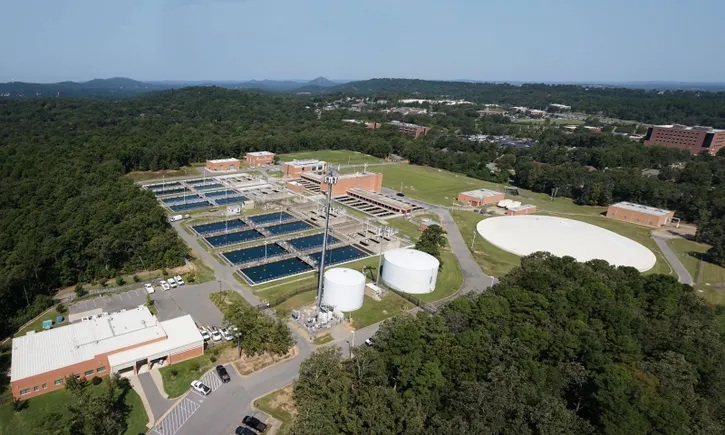
Arkansas' largest water treatment plant is undergoing its first major overhaul, costing $230 million. According to Douglas Shackelford, spokesperson for Central Arkansas Water, early construction at the Little Rock facility began about a month ago.
The renovation of the nearly 70-year-old Jack H. Wilson Water Treatment Plant is the largest project in Central Arkansas Water's history. Shackelford told Construction Dive that the project aims to secure the region's drinking water supply for decades to come by improving plant efficiency, addressing deferred maintenance, and equipping it with modern water treatment technology.
Mandeville, Louisiana-based Max Foote Construction is serving as construction manager at risk, according to Shackelford. New York City-based Hazen and Sawyer, along with Fort Smith, Arkansas-based Hawkins-Weir Engineers, have been hired to collaborate on design-phase services.
The Central Arkansas Water board approved issuing up to $230 million in bonds for the plant renovation on June 12, according to board documents. The board had approved a $219.2 million guaranteed maximum price construction contract in March, and officials hope to close the bond deal by July, as reported by the Northwest Arkansas Democrat-Gazette.
Construction will proceed in phases, during which the Wilson plant will continue operating, with the entire project expected to take about five years to complete, Shackelford said.
"This plant is critical to our system, so we can't shut it down. It has to keep running during construction," Shackelford said. "There are four large basins on site, and we'll essentially take one out of service for renovation while keeping the other three open and operational."
The Wilson plant currently has a daily treatment capacity of 133 million gallons, and after the upgrade, its capacity will increase to 150 million gallons, according to Shackelford. The facility draws water from the utility's own Lake Maumelle reservoir.
"[The new technology] will allow us to push water through at a faster rate, enabling the capacity increase," Shackelford said. "This will help us in the long run because, obviously, as the city grows and water demand rises, we need to have the ability to produce enough water."