
Portland's $2.1 Billion Water Treatment Plant Approved to Resume Work After Nearly Five-Month Shutdown
The Portland Water Bureau announced on June 25 that the Bull Run Filtration Project has been approved to resume work after a nearly five-month legal dispute shutdown. The $2.1 billion project aims to meet state and federal drinking water standards and remove Cryptosporidium. Previously, the Oregon Land Use Board of Appeals overturned Multnomah County's environmental approval, but a hearings officer re-approved the original land use permit on June 23.
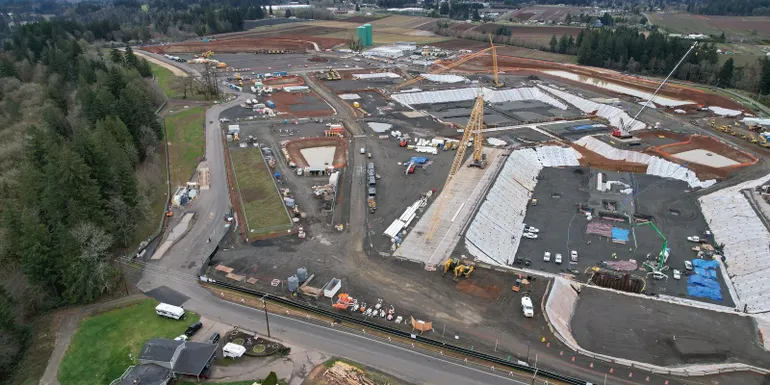
Briefing at a Glance
- Portland, Oregon, has been cleared to resume construction on a $2.1 billion water treatment plant after a legal dispute brought work to a halt for nearly five months. The dispute was initiated by nearby residents opposing the project. The news comes from a June 25 press release by the Portland Water Bureau.
- The Bull Run Filtration Project broke ground in June 2024 but stalled in January of this year when the Oregon Land Use Board of Appeals overturned Multnomah County's earlier environmental approval and required it to reconsider its decision. Construction has been paused since February 14, according to Oregon Public Broadcasting.
- Local residents and businesses filed lawsuits asking the state to block the project, citing negative impacts on natural resources, as documented in June 23 filings with the Multnomah County Land Use Commission. However, the hearings officer disagreed with their interpretation and re-approved the previous land use permits.
In-Depth Analysis
According to the project website, the goal is to bring the city into compliance with state and federal drinking water regulations and to remove the microscopic parasite Cryptosporidium. The project includes a new water filtration facility with a daily capacity of 135 million gallons, as well as new seismic-resistant pipelines.
Portland faces a federal deadline to have the filtration system operational by September 2027, the project website shows. The city chose a filtration approach that requires more infrastructure than some other available treatment methods, in order to address potential wildfires or landslides that could contaminate the Bull Run watershed, ABC 8 News reported.
"This decision allows us to move forward with protecting public health and providing resilience against wildfires, landslides, floods, and other natural disasters," Mayor Keith Wilson said in the press release. "The city is eager to get hundreds of construction workers back on site to complete these critical water system improvements."
Contractors began moving equipment and personnel to the site last week, Portland Water Bureau spokesperson Bonita Oswald said in an email.
The MWH-Kiewit joint venture, consisting of MWH Constructors, based in Broomfield, Colorado, and Kiewit, based in Omaha, Nebraska, serves as construction manager and general contractor for the filtration facility. The Bull Run Conveyance Partners joint venture, made up of James W. Fowler Co. of Dallas, Oregon, and MWH Constructors, is handling the CM/GC work for the pipelines.
Residents of the rural eastern Multnomah County community where the plant is located have opposed the project, concerned about impacts on farmland and hoping for cheaper alternatives, according to Oregon Public Broadcasting. These delays have driven up project costs: they have quadrupled since 2017, when the estimate was $500 million.