
Chicago Suburb School District Deploys Nation's First Dynamic Closed-Loop Geothermal Heat Pump System
North Shore School District 112 in Illinois, USA, has installed the nation's first dynamic closed-loop geothermal heat pump system at the 130-year-old Ravinia Elementary School. The system uses groundwater for efficient heat exchange, has a small footprint, is expected to reduce carbon emissions by about 30%, and leverages local, state, and federal incentives to offset 50% of the $6.7 million project cost.
At a Glance
- Trane Technologies announced on June 30 that a 130-year-old elementary school in a Chicago suburb will adopt a new geothermal heat pump system to provide comfortable temperatures for approximately 68,000 square feet of building space while significantly reducing energy costs.
- The system, located in Highland Park, Illinois, is a dynamic closed-loop geothermal heat pump system that leverages the superior heat transfer properties of flowing water. Its ground footprint is much smaller than other geothermal heat pump designs, making it well-suited for suburban schools.
- North Shore School District 112 combined local, state, and federal incentives to offset up to 50% of the $6.7 million project cost. Trane stated that the system is expected to reduce the facility's carbon emissions by approximately 30% while lowering operating and maintenance costs.
In-Depth Analysis
Educational institutions are showing growing interest in geothermal heat pump systems, with colleges and universities from Colorado to Vermont researching or actively building related infrastructure to improve heating and cooling efficiency in campus buildings.
Trane stated that the dynamic closed-loop geothermal heat pump system deployed by North Shore School District 112 at Ravinia Elementary School is the first of its kind in the United States.
Dynamic closed-loop systems work by absorbing and releasing heat to and from groundwater. Andy O'Fallon, a turnkey project developer at Trane Technologies, said in an email that groundwater depth and flow rates vary by location, so any facility owner considering a dynamic closed-loop system should conduct geological studies to confirm whether local resources are sufficient.
If resources are insufficient, a traditional dry-rock geothermal heat pump may be more cost-effective. However, such systems typically require more boreholes and have a larger physical footprint.
O'Fallon said, "The choice of which option mainly depends on available land area and hydrogeological conditions. This site did not have enough land to accommodate a traditional geothermal heat pump solution."
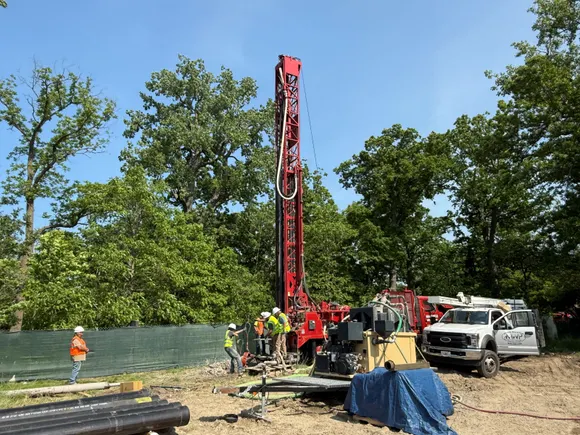
O'Fallon noted that a traditional geothermal heat pump system of similar scale might require 50 wells, while the system at Ravinia Elementary School only requires drilling 3 wells in 10-inch boreholes. If the aquifer flow rate meets the "ideal predicted design," each well can provide up to 150 tons of cooling and 50 tons of heating at full load.
On the ground side, the system is equipped with more than 50 water-source heat pumps, along with a single-cell cooling tower for backup cooling and an electric boiler for backup heating. O'Fallon stated that the heat pumps exchange thermal energy with the building's water circulation system, with water temperatures ranging between 40 and 90 degrees Fahrenheit.
The school district had an existing partnership with Trane, which helped alleviate officials' initial hesitation about adopting unfamiliar technology. James Bock, the district's director of operations, facilities, and transportation, said in a video describing the project: "We trusted that, given our relationship with Trane, what they brought to us was definitely worth looking at."
According to O'Fallon, District 112 deployed the dynamic closed-loop system as part of a larger renovation project. He added that the district's other facilities have also recently undergone sustainability upgrades, including rooftop solar panels and building automation improvements.
O'Fallon also mentioned that Trane worked with the district's accounting firm to provide the technical documentation needed to support its application for federal clean energy tax credits.
The One Big Beautiful Bill Act, signed by President Trump on July 4, significantly shortened the eligibility window for these tax credits and added new restrictions that experts say could make applications nearly impossible.