
New York State contractors oppose the nation's first data center moratorium
New York State Governor Kathy Hochul signed an executive order suspending environmental permits for hyperscale data centers, making the state the first in the nation to implement such a moratorium. Construction industry organizations have strongly opposed this move, arguing that it will harm the economy and weaken competitiveness.
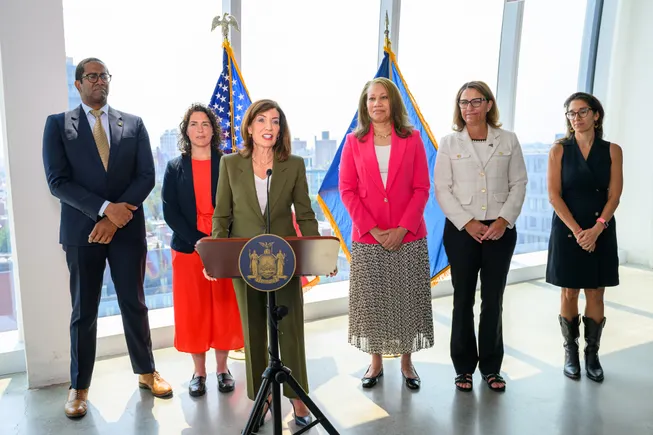
New York state has implemented the first statewide data center moratorium in the U.S., after Governor Kathy Hochul signed an executive order pausing new permits. The executive order, signed Tuesday morning, directs the state Department of Environmental Conservation to pause environmental permits for hyperscale data centers for up to one year.
During the pause, Hochul directed the state Department of Public Service to develop a generic environmental impact statement for data centers, aiming to allow data centers in development to follow consistent standards, according to the announcement.
Currently, data center projects that have obtained all necessary permits will not be hindered. The moratorium applies to projects using 50 megawatts or more of power that still require approval from the Department of Environmental Conservation.
"As data center development threatens to drive up utility bills, deplete natural resources, and create uncertainty for New Yorkers, I have a responsibility to act and lead," Hochul said in a press release detailing the order.
The moratorium is another step in an ongoing debate over how the state handles data centers. Last month, the state legislature passed a broader bill applying to projects of 20 megawatts or more, but according to Reuters, it has not yet been sent to Hochul's desk.
Builder reaction
Construction industry groups condemned the moratorium.
"This effectively closes the door on these projects, sending a strong signal to those seeking to make massive investments in New York that maybe they should think twice," Mike Elmendorf, president and CEO of the Associated General Contractors of New York State, told Construction Dive.
Carlo Scissura, president and CEO of the New York Building Congress, said the move would wreak havoc on New York's economy.
"This data center moratorium will harm our state's economy, our workforce, and our competitive position in future industries: plain and simple," Scissura said in an email statement to Construction Dive. "Our message is simple: a one-size-fits-all moratorium is the wrong tool to address a real problem that requires careful consideration."
Elmendorf added that the moratorium leaves members of the association who have already taken on data center work but have not yet obtained permits in a difficult position.
"These are massive, complex projects," Elmendorf said. "Not only are the opportunities likely to disappear, but these companies have given up other opportunities to prepare for building data centers. So it's very disappointing."
Brian Sampson, president of the Associated Builders and Contractors Empire State Chapter, said this development puts New York at a competitive disadvantage.
"This moratorium is another missed opportunity for New York. Data centers create high-quality construction jobs, strengthen our economy, and attract the kind of long-term private investment every state should be competing for," Sampson wrote in an email to Construction Dive. "Instead, New York has chosen to hit pause, again signaling to businesses seeking investment and growth that they might be better off going elsewhere. This is the wrong message at the wrong time."
Data center projects have become the "golden goose" of the construction industry in 2026. Over the past year, these large-scale projects have surged while most other sectors of the construction industry have been weak. Beyond the data centers themselves, utilities and specialty firms have also found success in creating related infrastructure for these massive projects.
Community opposition
Although data centers are a major boon to the construction industry, communities across the country are fiercely opposing the expansion of hyperscale data centers in their backyards. Questions about power access and prices, clean drinking water, and other community impacts dominate the debate.
"Technology should make our lives better, not pollute our water, strain our grid, or drive up our utility bills," New York State Senator Kristen Gonzalez said in Hochul's press release.
Indeed, power access has become a hot-button issue in New York. The state's aging grid, combined with already strict environmental policies, has partly hindered data center construction in the state.
Hochul also ordered the Department of Public Service to consider a mechanism to offset higher utility costs by having data centers pay for grid improvements, participate in demand response programs, support clean energy, and establish a developer-funded insurance pool.
This approach echoes calls some construction professionals made earlier to prevent the moratorium. Earlier this year, panelists at the New York Building Congress suggested data center projects develop community benefit plans to help ease public opposition.
As a harbinger of reaction to today's news, panelists at the time argued that a one-size-fits-all moratorium could "throw the baby out with the bathwater."
"When you say 'no,' the industry goes elsewhere," Rob Löbner, a principal at San Francisco-based design firm Gensler, said during the panel. "We should say 'yes,' but with the right conditions."
Correction: A previous version of this story misspelled Carlo Scissura's last name. It is Scissura.