
Border Wall 'Breakup' Moment: What Will Contractors Face if Biden Takes the White House?
If Joe Biden is elected president and fulfills his promise to 'not build another foot of wall,' contractors and subcontractors on the U.S.-Mexico border wall will face a complex situation of contract termination. Based on legal expert analysis, this article interprets the compensation process under 'termination for convenience' clauses, subcontractor risks, and uncertainties about where funds will go.
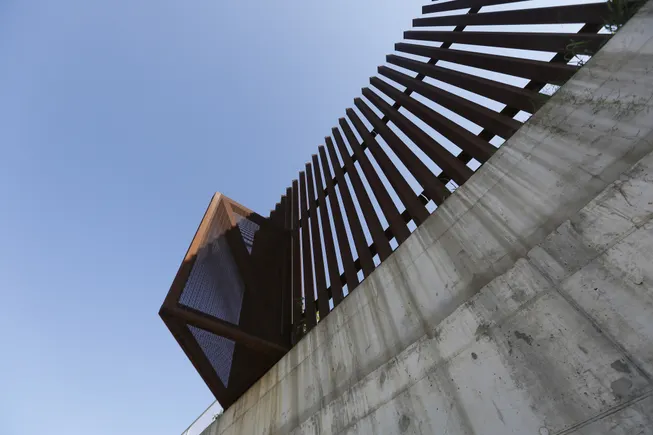
This story is the first in a two-part series examining the potential ripple effects of a Biden victory on contractors and subcontractors involved in building the U.S.-Mexico border wall.Click here to read Part Two。
In an interview this summer, former Vice President and Democratic presidential nominee Joe Biden told NPR that if elected, his administration would not build"another foot of wall"along the U.S.-Mexico border. Instead, he said he would rely on high-tech alternatives to secure the border, focusing on ports of entry where "all the bad things are happening." He also made clear he would not tear down existing wall segments.
Such a halt would no doubt be welcomed by Democrats, activists and others opposed to President Donald Trump's vision for a barrier spanning nearly the entire length of the southern border, including stretches near wildlife refuges and other environmentally sensitive areas.
According to White House data, the administration has overseen the completion of 370 miles of barrier since Trump took office. To date, Trump officials haveidentified $15 billion to build 738 miles of border wall, typically in the form of steel bollard fencing. Funding has come partly from appropriations approved by Congress through the traditional process, but largely from reprogrammed funds for military construction and counterdrug programs.
Companies awarded border wall work
- Barnard Construction (Bozeman, Montana)
- BFBC (Bozeman, Montana)
- Bristol Construction Services (Anchorage, Alaska)
- Burgos Group (Albuquerque, New Mexico)
- CJW JV (Santa Ana, California)
- Fisher Sand and Gravel (Dickinson, North Dakota)
- Gibraltar-Caddell JV (Montgomery, Alabama)
- Martin Bros. Construction (Sacramento, California)
- Posillico Civil/Coastal Environmental Group JV (Farmingdale, New York)
- Randy Kinder Excavating (Dexter, Missouri)
- SLS Ltd. (Galveston, Texas)
- Southwest Valley Constructors (Albuquerque, New Mexico)
- SWF Constructors (Omaha, Nebraska)
- Texas Sterling Construction (Houston)
- West Point Contractors (Tucson, Arizona)
The president was able to tap into Defense Department funds based on hisnational emergency declarationissued in February 2019. That move was opposed by Democratic lawmakers and is among the border wall disputes currently before federal courts. So far, the U.S. Supreme Court has prevented lower courts from halting construction.
So what happens if Biden wins and follows through on his promise to halt border wall construction? What would a stop-work order mean for contractors and subcontractors working on these projects?
Termination for convenience
Like the private sector, federal government contracts include clauses allowing termination for default or for convenience. The latter means the government can cancel a contract and abandon a project for almost any reason, said Doug Tabeling, an attorney with Smith, Currie & Hancock LLP in Atlanta.
For contractors that have just won a bid or recently signed a contract, a termination might be little more than paperwork, he said. But for contractors that have done significant planning or are in the middle of construction, the termination process can get a bit more complicated.
Related: Should contractors that have worked on the border wall worry about being blacklisted from state and local projects?
"Assuming the contract includes the standard termination for convenience clause found in other federal construction contracts, the contract more or less converts into a cost-plus-reasonable-profit agreement," Tabeling said.
So, he said, in a standard termination for convenience scenario, border wall contractors would need to submit a settlement proposal based on their costs, which could include:
- Labor and materials already expended.
- Storage materials that cannot be returned.
- The difference between the purchase price of heavy equipment and its current value.
- Securing the project site to ensure it does not pose a threat to the public or to completed work.
In calculating settlement profit, the government typically tries to be fair, but contractors should not expect a windfall, he said. The contracting agency will likely want to see the original estimate to determine the profit margin the contractor expected to make on the project, then look at the project's books to see what margin they actually realized, Tabeling said. To increase the likelihood of a settlement proposal being accepted, he said, contractors should make sure to include supporting documentation to back up their claims.
Given public sentiment about building the wall and the potential politics surrounding a decision to halt, he said, contractors' settlement proposals could face more scrutiny than usual.
Risks and rewards
The potential termination of border wall construction is an example of the risks contractors take when signing agreements for controversial or political projects, said Angela Styles, an attorney with Akin Gump Strauss Hauer & Feld LLP in Washington, D.C.
However, the biggest risk for a general contractor facing termination for convenience lies in terminating its agreements with subcontractors, she said.
Savvy contractors will include clauses in their subcontracts that mirror the government's termination for convenience rights, Styles said. Without them, those contractors could find themselves owing subcontractors the profit they expected to make on the entire project, not just the work completed up to the termination. That liability could also extend to lower-tier subcontractors.
Contractors that take action to recover more from the government than is typically allowed under a termination for convenience will face an uphill battle, Tabeling said. There are only a few very narrow exceptions to the government's termination for convenience rights.
"If it's done in bad faith, meaning the government is actually targeting a particular contractor in bad faith and terminating its contract for reasons unrelated to the work, the government's own priorities or the government's own needs," Tabeling said.
Financial implications
For nearly four years, lawyers for the Trump administration have spent considerable time in court defending border wall construction on several fronts.
So far, they have been largely successful in defending the project against environmentalists. The Department of Homeland Security routinely waives environmental laws such as the Clean Water Act, the Clean Air Act and the National Environmental Policy Act to expedite construction.
The Trump administration has had more difficulty justifying the diversion of military funds to pay for the project. Democratic lawmakers have accused the White House of trying to bypass Congress, which refused to fund the project at the level the president requested.
Federal courts have ruled that the situation at the border did not rise to the level of a national emergency and that the Trump administration could not divert military funds to secure the region, but a favorable Supreme Court ruling has meant the border wall project has proceeded.
However, if Biden wins, it does not automatically mean the diverted funds would be returned to the Defense Department or the Treasury, because the transfer of those funds is a new development, said Jordan Howard, director of the Federal & Heavy Construction Division at the Associated General Contractors of America.
"It's not new for the government to stop, change its mind or cancel a project. It happens all the time. But reprogramming funds on this scale is really new," Howard said.
Possibilities include using the funds for electronic surveillance and monitoring systems, using a large chunk of it for completed work and termination fees paid to contractors, or returning it to the budget, he said.
"It's complicated," Howard said.