
COVID-19 Prevention Outcomes in the Construction Industry May Be Less Optimistic Than Expected
The effectiveness of COVID-19 prevention and control in the U.S. construction industry during the pandemic has been called into question. Although the industry generally believes that on-site epidemic prevention measures are effective, multiple studies and local public health data show that the construction industry ranks among the top in the number of outbreaks in several states, with workers facing significantly higher hospitalization risks than other industries. The lack of a national data tracking system makes it difficult to assess the true infection situation in the industry.
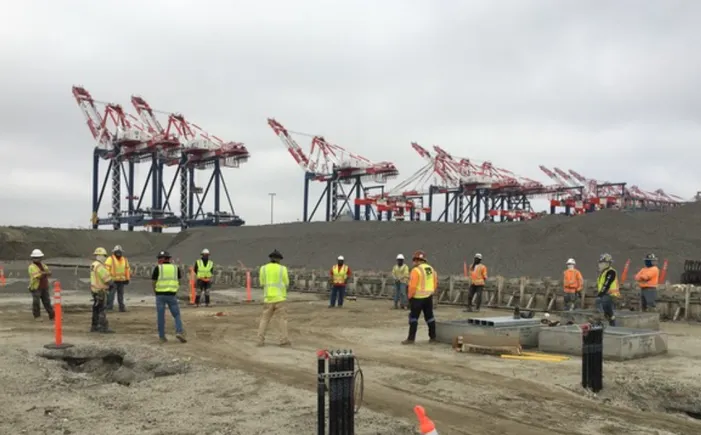
For a long time, it has been widely believed that the U.S. construction industry has performed relatively well in preventing the spread of COVID-19. Although outbreaks occurred at high-profile projects such as Allegiant Stadium in Las Vegas and at as many as 13 sites in the San Francisco Bay Area, the industry as a whole has not attracted as much attention as healthcare, nursing homes, and meat processing industries, which have been severely impacted by the pandemic.
Stephen Sandherr, CEO of the Associated General Contractors of America (AGC), wrote in a letter to members earlier this month: "Our industry has not suffered the kind of widespread workplace outbreaks that have plagued many other sectors of the economy." He encouraged companies to remain vigilant during the resurgence of the pandemic, when daily new cases nationwide exceeded 160,000.
However, academic research, increasing local public health data, and sporadic media reports are beginning to question the construction industry's "clean record" in pandemic prevention. The following data is worth noting:
- According to data from the Washington State Department of Health, as of November 12, the construction industry had experienced 106 COVID-19 outbreaks in the state, ranking third among all settings, behind only restaurants and produce packaging industries.
- Data tracked by the Michigan Department of Health and Human Services shows that as of November 12, the total number of outbreaks in the construction and manufacturing industries ranked third among all settings, behind only long-term care facilities and schools.
- According to data from the Nashville Metropolitan Public Health Department, the number of COVID-19 clusters at construction sites ranked second in Nashville, Tennessee, behind only long-term care facilities and higher than bars.
- A study conducted by researchers at the University of Texas at Austin's COVID-19 Modeling Consortium found that construction workers in Texas were five times more likely to be hospitalized for COVID-19 than workers in other industries.
- A study by the U.S. Centers for Disease Control and Prevention (CDC) of workplace outbreaks in Utah found that the construction industry had the second-highest number of cases among all industries studied.
Divergent Views
These data contradict the widely held belief that mitigation measures such as screening, personal protective equipment, and social distancing at construction sites have effectively curbed the spread of COVID-19 in the construction industry. The data also raise questions about another issue: in the absence of national data on COVID-19 infections by occupation in the United States, has the construction industry—an industry considered essential in most states and continuing to operate—really done enough to prevent workplace transmission, as it believes it has?
David Bui, a CDC Epidemic Intelligence Service officer and co-author of the Utah construction industry outbreak study, said: "Outbreaks at construction sites may be very common. Collecting workplace outbreak data has been challenging for many health departments, so national-level data is not available."
"Our industry once again finds itself one step away from being forced to shut down." — Stephen Sandherr, CEO of the Associated General Contractors of America
These aggregated data come at a time when several states are re-tightening restrictions due to surging cases, and some are even closing certain business sectors again. Virginia, Michigan, and Oregon have implemented emergency regulations, including requirements for screening employees and visitors, maintaining physical distance, and wearing masks and face coverings.
The AGC's November 3 letter to members urged companies to remain vigilant, driven by concerns that the initial workplace lockdowns from March could re-emerge. Sandherr wrote in the letter: "Unfortunately, case counts in many areas have begun to grow at an alarming rate. It is foreseeable that in the coming weeks or months, many state and local officials will face immense pressure to implement new lockdown measures similar to before. In other words, our industry once again finds itself one step away from being forced to shut down."
Lack of National Data
Several experts interviewed said the problem is partly that there is currently no single source to track COVID-19 infections in the construction industry at the national level. While the U.S. Occupational Safety and Health Administration (OSHA) tracks positive workplace cases through its Form 300 (log of work-related injuries and illnesses), these data are only compiled annually.
Brian Turmail, vice president of public affairs and strategic initiatives at AGC, said the association's position that the construction industry has so far contained large-scale outbreaks is based on the lack of outbreak cases in media and company reports compared to other industries. "This is based on the absence of data," Turmail said. "Many other sectors of the economy have experienced widespread shutdowns. At the same time, we really haven't heard from our members about any major shutdowns due to COVID-19 or virus transmission at job sites."
Construction Dive has found news reports of more than 20 COVID-19 outbreaks at construction sites in the United States and Canada. View our tracker here.
"Some smaller sites simply don't have the capacity to have the resources to deal with an outbreak." — Remy Pasco, researcher at the University of Texas
But other industry observers say COVID-19 cases at construction sites are almost certainly more numerous than publicly tracked. Russell Carr, president of Berg Compliance Solutions, a health and safety consulting firm based in Austin, Texas, said: "When you add it all up, there really are outbreaks, they're just not being reported." He believes part of the problem is the construction industry's "tough guy" attitude toward working while sick, and that workers have no financial incentive to honestly report potential exposures or even positive test results, knowing they would miss work if they did. "People have every reason to ignore it and go to work, and no reason to report it and stay home," Carr said. "People just keep going to work."
Turmail said some contractors do provide paid sick leave for workers who test positive for COVID-19.
Inconsistent Implementation of Mitigation Measures
Remy Pasco, co-author of the University of Texas study and graduate research assistant, said construction workers are five times more likely to be hospitalized for COVID-19 than workers in other industries, partly simply because they continued going to job sites during the pandemic while people in other occupations worked remotely. "I should note that the rest of the population we compared these workers to is everyone not working in construction," Pasco said. "Some people in other industries are essential workers, and some may also be working from home."
He said the study's control group came from anonymized data of more than 2,200 COVID-19 patients admitted to hospitals in the Austin area as of August 20, including individuals in healthcare, agriculture, education, and legal industries, as well as retired and unemployed workers. He also said researchers saw evidence of inconsistent implementation of mitigation measures across different sites, especially between large and small sites. "I don't want to generalize and say all construction sites are doing a poor job, because we know that's not the case," Pasco said. "We've seen exemplary sites where people wear masks, wash hands, and maintain social distancing as much as possible. But go a block further, and some smaller sites simply don't have the capacity to have the resources to deal with an outbreak."
The study, published October 29 in JAMA Network Open, aimed to validate a model developed to help the city of Austin decide whether construction sites should remain open during the pandemic. The model proved with high accuracy its prediction: construction workers were four to five times more likely to be hospitalized for COVID-19 than those in other industries. "This is no longer our guess," Pasco said. "This is what we've seen and confirmed." But Pasco also acknowledged that the study did not examine causation; it only observed data collected from COVID-19 patients across numerous industries, including construction. In other words, the study did not conduct analysis or contact tracing to determine how these patients contracted the virus.
Off-Site Exposure
Turmail noted that a later report indicated the COVID-19 outbreaks among Austin construction workers were due to social activities outside of work, not their behavior at job sites. "The real challenge is that construction has a unique demographic profile, especially in Austin, where living conditions and social environment have a greater impact than a lack of safety precautions at job sites," Turmail said. "But that doesn't change the fact that a higher proportion of COVID-19 infected individuals clearly still poses a higher risk to other workers, and we must guard against that."
Executives at large construction companies, including New York-based Plaza Construction, Minneapolis-based Mortenson Construction, and San Jose, California-based subcontractor Rosendin Electric, said the industry's growing challenge is managing workers' behavior outside of work. Derek Cunz, senior vice president at Mortenson, said: "When we have COVID-19 cases on our projects and we investigate through contact tracing, the vast majority of infections stem from activities outside of work. We've been reminding people and promoting more the importance of making safe choices outside of work." Mortenson formed a joint venture with McCarthy to build Allegiant Stadium in Las Vegas, where at least 31 workers tested positive for COVID-19 in May.
Recent research by the National Institute for Occupational Safety and Health (NIOSH) suggests that construction workers engage in higher rates of social and other behaviors that put them at risk for COVID-19 infection. The study found that six health risk behaviors were more common in construction: smoking, using smokeless tobacco, heavy drinking, lack of leisure-time physical activity, not always wearing a seatbelt, and getting less than seven hours of sleep per day.
However, health experts also dispute the increasing tendency to blame social gatherings outside of work rather than making harder decisions to stop workplace transmission. "If officials imposed stricter restrictions on business and non-residential activities, family gatherings would be much safer," Boston University epidemiologist Ellie Murray recently told The New York Times. "They choose not to do that, and then say the fault lies with individuals."
Advantages of Outdoor Work
Several sources interviewed said that if COVID-19 case numbers at construction sites were indeed significantly higher than commonly perceived, the public would have heard about it by now, even without a national data reporting framework. Consider the experience of Dr. Dan Carlin, CEO of New Hampshire-based JobSiteCare, which provides telemedicine services to remote construction sites. Since the pandemic began, he has coordinated daily COVID-19 screening for 10,500 workers at Florida-based Moss Construction. During this period, he found only 171 confirmed cases among these construction workers, less than 1.6% of the entire workforce. And thanks to these daily screenings (including mandatory temperature checks), Moss experienced no shutdowns during this time.
But while Carlin views screening, social distancing, and mask-wearing as the "holy grail" of mitigation measures that produced these results, as a physician he also knows that many fundamental characteristics of the construction industry work in his favor. These include the industry's normal requirement to wear personal protective equipment as a job requirement, and the fact that many sites are essentially outdoors, which has proven to be one of the strongest factors in stopping the spread of COVID-19. "When this pandemic started in February, we thought it was a surface virus," said Carlin, a former U.S. Navy medical officer who this year also oversaw the WNBA season bubble, which achieved zero COVID-19 transmission. "But what we learned is that the virus really brings us down by entering the air in enclosed environments."
Carlin said if forced to choose between handwashing and mask-wearing as a way to mitigate the spread of COVID-19, he would choose masks without hesitation. "Honestly, the most important thing is you have to limit air exposure," Carlin said. "And the way to do that is to work outdoors."
Incomplete Data
Brian Knudsen, vice president of Portland, Oregon-based Andersen Construction, knows this well. An indoor pre-construction meeting held internally in October led to an outbreak. According to the Jackson County Health Department, a total of 16 cases were linked to the meeting, including 13 employees and 3 close contacts. Knudsen said people wore masks during the meeting, but sometimes workers would remove masks indoors and instead choose to maintain social distancing. "We learned that this is a highly contagious disease," Knudsen said. Like others in the industry, he believes that increased activity outside of work is now exacerbating risks at the workplace. "It feels like things are reversing; before it might have been work bringing the virus home, now it might be more that home is bringing the virus to the workplace," Knudsen said.
The lack of comprehensive national data on the number of outbreaks in the construction industry leaves the industry guessing how its true infection numbers compare to other industries. "We see widespread outbreaks in other industries, but we don't see them in construction," said Jack Dennerlein, a professor at Northeastern University in Boston who studies occupational health and safety in construction. "But we also don't have good surveillance systems. So these outbreaks we see in other industries might just be the tip of the iceberg poking out of our poor data systems. Beneath the surface, something might be happening in construction that we just can't measure."
Editor's note: This article has been updated to clarify the COVID-19 testing results of the WNBA season bubble.


