
Why Modular Construction Has Not Fully Taken Off in Commercial Buildings
Modular construction was once highly anticipated, but in 2023 its share of new buildings in North America was only 5.5%. Contractors report that obstacles remain in design, manufacturing, transportation, and assembly stages, with a steep learning curve. Despite challenges, industry experts expect the market share to double to 10% over the next five years, with increasing applications particularly in healthcare and hospitality sectors.
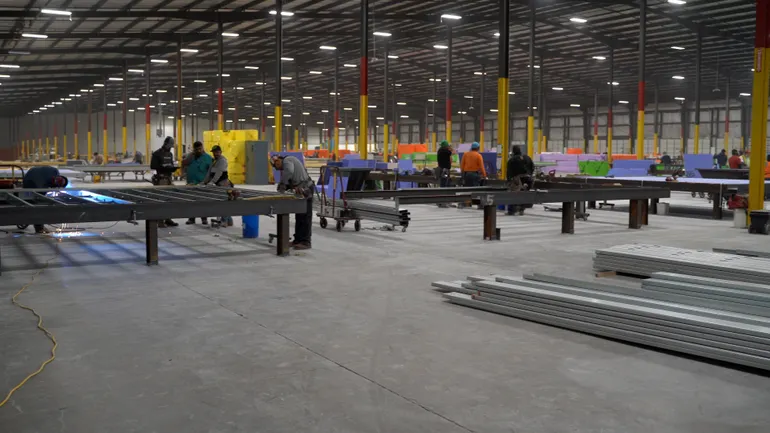
The vision is grand, the predictions ambitious: permanent modular construction was supposed to transform the industry, saving time, money, and protecting the environment. Yet, years after its initial adoption in the U.S. market, the method accounted for only 5.5% of new North American construction last year, according to the Modular Building Institute (MBI).
Despite modular construction's promises of lower costs, environmental benefits, and faster returns on investment, contractors still encounter significant hurdles when using it. They say many face a steep learning curve, and errors can occur in design, manufacturing, transportation, and assembly.
"In theory, if everything goes according to plan, modular construction should save both time and money. But modular technology hasn't fully conquered the challenges of commercial buildings and other more complex building types," said Raja Ghawi, a partner at real estate technology venture firm Era Ventures. Ghawi previously served as investment director at Suffolk Construction in Boston.
Of course, many construction professionals recognize modular's potential, especially in specific market segments.

"Over the past five years, our market share has doubled... I expect it to double again to 10% in the next five years, driven by the same factors fueling current growth," said Tom Hardiman, executive director of MBI.
"More owners and architects understand the process, the labor market is tight, and there's a severe housing shortage—these factors won't change in the next five years in a way that negatively impacts the industry," he said.
Turner Burton, president of Hoar Construction, a Birmingham, Alabama-based construction firm, said modular construction is particularly gaining traction in the healthcare sector. The repetitive nature of identical patient rooms or bathroom modules is well-suited for modular operations.
"You have to think about and plan every step of manufacturing, transportation, and installation," Burton said. "You have to get the people responsible for installation and assembly working together in the same room."
For example, in one of Hoar's current projects (pictured above), subcontractors were involved in the design phase to ensure that fully prefabricated exterior wall panels could be lifted by crane and installed onto the building's facade.
Modular construction has also made inroads in the hotel industry, with well-known brands like Hilton and Marriott havingexpressed approval。
Contractors also recognize its green and safety benefits. According to the2020 Dodge SmartMarket Report, about 88% of contractors said modular construction reduces construction waste.
Meanwhile, building in a factory setting eliminates the risk of falls from heights—the leading cause of construction fatalities. According to Dodge, about 89% of respondents believe modular provides a safer workplace.
Additionally,according to MBI, modular construction saves 25% to 50% of construction time compared to traditional methods, meaning faster occupancy and return on investment.
Why modular hasn't fully taken off yet
Despite this, contractors say certain challenges in modular projects hinder its progress. One of the biggest challenges lies in handling the new approach of each project.
"Everyone needs to stop, temporarily set aside their existing knowledge of construction, and relearn how to sequence, phase, choreograph, and coordinate modular components with all the infrastructure," said Jared Bradley, president of The Bradley Projects, a Nashville, Tennessee-based construction firm. "It's a completely different learning curve."

Architects, consultants, general contractors, and subcontractors all need retraining, including how to monitor quality and track progress, Ghawi said.
Another challenge is that initial cost savings are often offset by design, manufacturing, or execution errors on site, Ghawi said. These issues can involve component assembly, factory transportation and loading/unloading, or proper installation techniques.
Modular's pre-assembled components also undercut some subcontractors' business, especially highly skilled trades like plumbers, electricians, and ironworkers, said Scott DeLano, head of Certified Construction Services, a general contractor based in Nashville, Tennessee.
These modules "come with plumbing and electrical already installed, so we basically just provide the foundation, landscaping, site grading, and all necessary infrastructure to have a place for these modules to arrive," DeLano said.
Because the methods are so different and infrequently used, contractors and subcontractors struggle to establish a steady rhythm.
"Once you finish a modular project, you go back to traditional methods for a year or two, three or four, and then suddenly someone proposes another modular project," Bradley said. "Everyone has to rethink everything they did before."
Protection against damage during transportation is another issue.
"Building and transporting a modular bathroom or unit requires additional structure beyond what would be needed if built on site," said an executive at a general contractor who spoke on condition of anonymity, fearing to offend potential business partners. "You're actually putting more material into the prefabricated module than you would if building efficiently on site."
Withmaterial prices at 35-year highs, any additional cost is unwelcome.
"For prefabricated construction, that's why establishing consistency and repetition is important to maximize production efficiency and offset the costs of additional rigidity and stability requirements during transport," the executive said.
Growth prospects
Despite the obstacles, modular's market share is still expected to grow. For example, according to MBI, homes built using modular processes use about 17% less material overall.
Modular housing development company Cloud Apartments claims its construction process is30% more cost-effective。
Even Bradley, who mentioned the steep learning curve, still believes modular has a place in his business.
"There's a time and place for everything, and modular construction is no different," Bradley said. "It's always a tool in our toolbox. But I don't think it will ever be our primary tool."