
2024 Election Uncertainty Dampens Construction Activity, Public Projects Still Steadily Advancing
The latest index from the National Federation of Independent Business shows small business owner uncertainty at a record high. Construction industry professionals say election anxiety is dragging down overall construction activity, but public sector projects are still moving forward. The Federal Reserve's Beige Book and economists at multiple institutions have observed delays in private projects, while public areas such as infrastructure remain relatively immune.
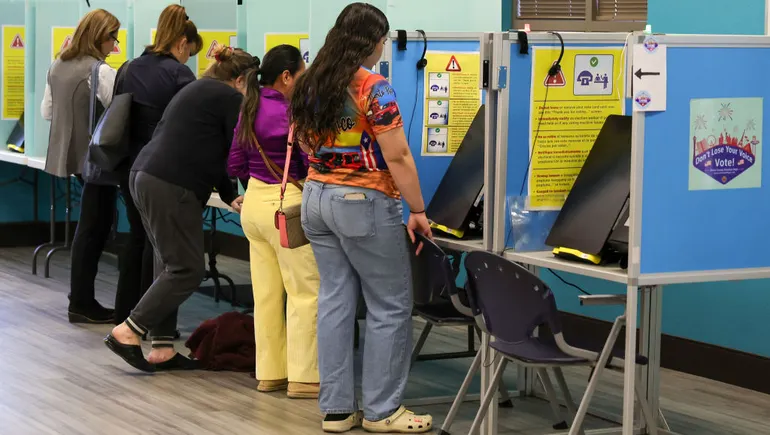
Election anxiety is affecting construction activity, although public sector projects are currently still moving forward.
According to the latest index from the National Federation of Independent Business, an industry group representing small businesses, uncertainty among small business owners across all industries recently reachedan all-time high. Industry insiders told Construction Dive that this anxiety, emerging during one of the most competitive presidential campaigns in recent years, is affecting overall construction activity.

"We are noticing uncertainty in the market about the potential economic impact of the election," said Granger Hassmann, vice president of preconstruction and estimating at Minneapolis-based construction management firm Adolfson & Peterson. "The overall market seems to be slowing down, especially in the private sector."
Hassmann added that while the level of uncertainty has increased in recent months, this trend has been evident over the past two years, and a "wait-and-see attitude" has further exacerbated the slowdown.

Meanwhile, the Federal Reserve's latest Beige Book report provides commentary on current economic conditions.The Federal Reserve Bank of Clevelandnoted that two unnamed commercial builders recently reported that many companies plan to wait until after the election to proceed with construction projects. According to theFederal Reserve Bank of New York, construction firms in New York also reported a moderate pace of decline in activity.
Leading indicators for construction
Architecture firms, often early indicators of future construction activity, are also noticing signs of a slowdown. Kermit Baker, chief economist at the American Institute of Architects (AIA), said design firms are feeling the pressure as the upcoming election casts a shadow over the expected economic recovery.
"We had expected a recovery to come as inflation concerns faded and interest rates eased, but election uncertainty seems to be suppressing any anticipated recovery," Baker said. "Architecture firms cite the upcoming election as a major reason for expected weakness in the second half of the year."

This hesitation is visible in other areas as well. For example, electric vehicle battery manufacturerUltium Cells recently paused its $2.6 billion plant in Lansing, Michigandue to weak demand and high interest rates. The company plans to resume the project once it gains a clearer economic outlook, reflecting the broader wait-and-see strategy Hassmann mentioned.
In Philadelphia, real estate developerShift Capital paused the renovation of the historic Beury Building in Augustdue to loan financing issues. Its CEO, Brian Murray, noted that high interest rates and cautious lenders have made banks reluctant to commit to large projects. This hesitation reflects broader concerns about the economic environment, including high interest rates andregulatory uncertainty.)
Michael Guckes, chief economist at Cincinnati-based construction data provider ConstructConnect, said this lack of clarity is fueling caution because different potential outcomes could create different policy environments.

"This issue is tricky overall because it largely depends on who controls the White House and Congress," Guckes said. "There are many 'divided government' scenarios where either candidate's presidential agenda could be broadly obstructed by an opposing Congress."
Public projects performing better
Infrastructure projects and public sector work appear to be the exception.

Ken Simonson, chief economist at the Associated General Contractors of America (AGC), said most public construction projects have long lead times and the structures are designed to last for years, so many owners are unlikely to delay once design, approvals, and financing are in place. He said AGC member firms have not yet reported election uncertainty as a reason for owners postponing public projects.
"I think public projects, such as infrastructure, schools, public safety, justice, prison structures, data centers, utility projects, and many manufacturing plants, are particularly immune to election uncertainty," Simonson said. "These happen to be the categories with the best outlook for 2025."
Nevertheless, Anirban Basu, chief economist at the Associated Builders and Contractors (ABC), said some funding programs, such as the CHIPS Act and the Inflation Reduction Act, which provide substantial subsidies to manufacturers investing in new domestic production capacity and alternative energy producers, could be significantly reshaped by a change in administration.
"This seems particularly evident in the energy sector," Basu said. "In one possible scenario, subsidies for alternative energy producers would be reduced, while support for traditional energy forms would increase."
For example, solar cell manufacturer Meyer Burger recently shelved its$400 million factory project in Coloradodue to financial constraints related to the Inflation Reduction Act and an uncertain economic environment. This reduced its potential debt financing, which in turn cut construction funding.

Basu also pointed to broader economic trends affecting contractors. For example, although construction material costs are 39% higher than in the early days of the COVID-19 pandemic, prices have stabilized over the past two years. Recent declines in energy prices have helped maintain this trend, but Basu warned that trade wars could reignite, especially involving tariffs on China, which would likely drive up construction costs.
He added that trade-related inflationary pressures could put upward pressure on interest rates, which contractors have been eager to see ease.
Will interest rates return to high levels?
Guckes said that if one party gains full control of the White House and Congress, the impact on construction would be more significant.
A Trump presidency combined with a Republican sweep of Congress could lead to increased deficit spending, lower corporate taxes, and higher tariffs. Guckes said this would create an environment mixing short-term growth with potential second-round inflation.
Assuming the Federal Reserve follows its 2022 and 2023 anti-inflation strategy, it would again use higher interest rates to curb inflation. Guckes said these rate hikes would profoundly affect owners' and developers' ability to finance new construction again.

"A repeat of 2022's rate hikes in 2026 or 2027 would negatively impact construction in the following year or years, just as it did in 2023 and 2024," Guckes said. "ConstructConnect's current expectation of 4% annual growth in construction for 2027 and 2028 would be at risk of significant downward revision."
Stricter regulations?
In contrast, a Harris administration combined with Democratic control of Congress might avoid aggressive short-term spending but could implement stricter environmental and labor regulations. Guckes said this could also slow construction activity.
"We don't expect a Harris administration to take an aggressive approach to boosting short-term growth," Guckes said. "This would spare the country from the worst inflation concerns. Strengthening environmental and labor regulations could slow the pace of new construction while increasing costs."
In either scenario, Guckes said the industry will soon gain clarity after Election Day based on the final results to resume or revise plans.