
Construction Industry Weighs Tariff Hopes and Concerns: H2 2025 Outlook
Five months after President Trump announced the "Liberation Day" tariff policy on April 2, 2025, the U.S. construction industry faces a significant surge in import tariffs on raw materials such as steel, aluminum, and copper. Industry opinions on the tariff impact are split into two opposing views: supporters argue that tariffs can drive manufacturing reshoring and promote industrial construction, while opponents emphasize the negative effects of rising costs, labor shortages, and policy uncertainty. Several industry economists and contractor executives have weighed in on the discussion, and the industry is actively adapting through diversified procurement and advance purchasing strategies.
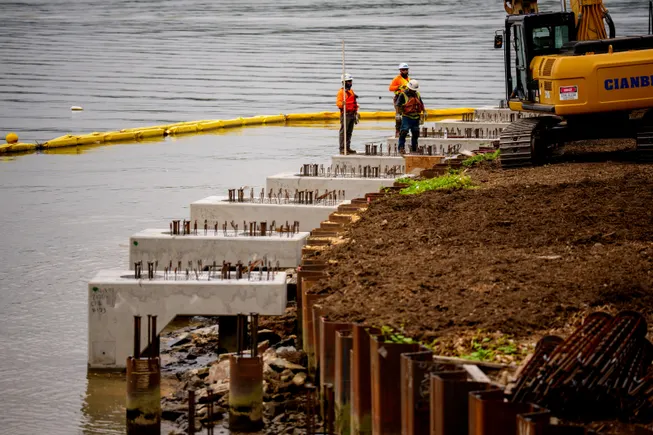
Five months after President Trump announced the "Liberation Day" tariff policy on April 2, 2025, nearly every project breaking ground carries a higher cost tag.
Due to the president's policy, steel, aluminum, copper, and various other construction inputs are now subject to high import tariffs. The price increases have significantly slowed the growth pace of construction spending across the United States.
Tariffs are now firmly embedded in the construction economy, no longer just a one-off political experiment. They are affecting projects under construction as well as those still in the planning stage.
Although a recent appellate court ruling could overturn some tariffs, it does not address tariffs on steel, aluminum, and copper, which remain unaffected.
Against this backdrop, contractors and construction economists have formed two distinctly different views on tariffs: one holds that tariffs help build domestic economic momentum, thereby stimulating more construction activity; the other holds that tariffs only increase construction costs.
Based on this, the real debate among construction industry executives in the second half of 2025 is not whether tariffs are good or bad, but whether a balance point exists—where tariffs increase costs in the short term while ultimately bringing long-term resilience to domestic builders and reversing the trend of U.S. manufacturing decline. So says Jay Bowman, a partner at FMI, a consulting firm headquartered in Raleigh, North Carolina.
"Think about the negative effects of 90 years of low tariffs: the loss of domestic manufacturing, and with it the disappearance of vocational education programs in schools," Bowman said. "The major challenge that has truly affected the design and construction industry over the past 50 years is the shortage of skilled labor."
The tariff balancing act
Bowman believes tariffs should be understood as part of a balancing act. If tariffs are too low, the United States remains vulnerable and overly exposed to global shocks; if tariffs are too high, costs spiral out of control, causing projects to be shelved.
But Michael O'Reilly, vice president at construction consulting firm Rider Levett Bucknall, says this balance only works if tariffs are predictable and sustained. Without stability, contractors will be reluctant to invest resources in production.
"Tariffs can play a role in bringing manufacturing back and boosting domestic production, but the key is long-term consistency for them to be effective," O'Reilly told Construction Dive.
Some economists, however, fundamentally doubt whether tariffs can provide such a balance. Ken Simonson, chief economist at the Associated General Contractors of America, believes the decline of U.S. manufacturing stems more from global cost dynamics than from tariff policy.

"U.S. manufacturing has shrunk mainly because labor costs are lower in European and Asian countries, and in some cases they have better access to raw or processed materials," Simonson told Construction Dive. "Low tariffs were only a secondary factor, and high tariffs are now insufficient to bring back significant manufacturing, especially when companies cannot count on tariffs being sustained, input supplies, or sufficient skilled labor."
Another focus of the debate centers on labor. Although tariffs may change the competitiveness of foreign goods, they clash with the reality of labor shortages. Michael Guckes, chief economist at Cincinnati-based ConstructConnect, says there simply are not enough available workers to both develop national infrastructure and shift labor to tasks previously done overseas at lower cost.
"Low tariffs did not hollow out U.S. domestic manufacturing; they more so slowed its decline," Guckes told Construction Dive. "Moreover, we cannot ignore the fact that today's vocational education pipeline is so narrow because too many young people have been pushed toward college education."
From this perspective, the real culprit behind the skilled labor shortage is the U.S. education system's "all-or-nothing" push for high school graduates to obtain college degrees. Guckes added that tariffs also rely on executive orders rather than legislation, making them politically vulnerable.
"Today's tariffs are the result of executive branch efforts, and without Congress codifying them into law, they could be quickly repealed by the next presidential administration in 2029," Guckes told Construction Dive. "This reality casts a shadow over profitable domestic production investments, which could quickly become failed ventures without long-term tariff support."
From a policy standpoint, Guckes believes the balance point is closer to zero tariffs. Broad trade barriers push up costs across the board while creating almost no new opportunities for the construction industry.

"Any tariff now only adds extra pressure on costs, further reducing returns on investment, and thus reducing construction output," Guckes told Construction Dive. "It is hard to assert that there is some ideal tariff level that could improve the industry's overall condition."
Postwar transformation
Others argue that regardless of policy, U.S. deindustrialization was destined to happen. Anirban Basu, chief economist at the Associated Builders and Contractors, says U.S. factories dominated after World War II because much of the world lay in ruins. As Europe and Asia industrialized, he believes the U.S. losing share was inevitable.
"The massive loss of U.S. manufacturing capacity over decades was inevitable, with or without tariffs," Basu told Construction Dive. "As more countries industrialized, including China, India, South Korea, Brazil, Mexico, and others, more countries became self-sufficient. It is conceivable that stringent regulations, unionization, and mismanagement also played roles in accelerating U.S. deindustrialization."
However, Basu acknowledges a small window of opportunity that the Trump administration's tariffs might create. He says tariffs can serve as a means of negotiation with other countries, which in turn could have a net positive impact on U.S. construction activity.
"Perhaps these high tariffs are a way to prompt other countries to lower their barriers to U.S. exports," Basu said. "If our barriers and their trade barriers collapse simultaneously, and the U.S. makes the right investments, U.S. manufacturing will be greatly strengthened."
Basu says this would lead to more industrial projects in the United States. As more supply chains return, the U.S. will become home to more manufacturers of intermediate products.
"For decades, many manufacturers moved to China and other countries because their suppliers had already moved there," Basu told Construction Dive. "But as supply chains mature, the appeal of offshoring is diminishing, meaning more industrial construction in the U.S. over the coming decades."
Meanwhile, Basu is skeptical of across-the-board tariffs, which he likens to a tax that creates inefficiencies.

"The higher the tariffs, the greater the efficiency loss. The U.S. prospered during periods of low tariffs," Basu said. "Perhaps the optimal outcome is targeted tariffs in areas deemed critical to national security, while maintaining low tariffs on nearly all other goods."
On the other hand, Simonson says protective policies rarely yield broad benefits.
"Measures that raise costs, such as tariffs, quotas, and unnecessarily strict regulations, are a net loss to the economy," he told Construction Dive. "Protected businesses may expand capacity, but they typically raise prices and strive to maintain barriers. Far more businesses and consumers pay more or face fewer choices than benefit from increased profits and jobs."
Acceptance and adaptation
Despite disagreements, construction industry professionals agree on two issues. First, tariffs push up input costs in the short term. Second, contractors are already adjusting as they plan for the second half of 2025.
In fact, mid-year market reports from three general contractors already show this shift.
Skanska and DPR both report a shift in procurement strategies, according to the latest construction market reports from these two general contractors. Meanwhile, Gilbane expects overall construction spending growth of just 1% in 2025, down from 6.5% in 2024.
The shift toward more diversified procurement involves early procurement packages and contingencies to spread risk between owners and subcontractors. This approach has been popular since the early days of the COVID-19 pandemic, and some contractors may even stockpile small imported items such as tools or fasteners, Guckes says.
Despite these strategies, Simonson says contractors may have little bargaining power in the face of tariffs in the long run. He notes that "power lies with the owners," since ultimately it is the owner who decides whether to accept price adjustments.
Industry differences
Industry exposure also plays a role.
Both Bowman and Basu point out that well-funded players in the data center and infrastructure sectors are better able to absorb cost increases caused by tariffs.
O'Reilly adds that beyond these industries, some publicly funded sectors, such as education and healthcare construction, are well positioned to mitigate the added tariff burden. According to Gilbane's third-quarter market conditions report, road, bridge, water, and waste treatment projects also offer construction opportunities.
But other private sector projects, such as office buildings or multifamily housing, are more likely to stall.
"Data centers are probably the most able to absorb tariff costs," Simonson told Construction Dive. "Compared to the revenue a new center can generate, tariff costs are negligible."