
Bedrock Robotics Deploys Fully Autonomous Excavators at Construction Sites
San Francisco-based construction technology company Bedrock Robotics announced on Monday that it has deployed fully autonomous excavators at multiple active construction sites across the United States. The system retrofits existing excavators with sensor and computing kits, enabling them to operate without an onboard operator, and is currently in use at a Nevada water treatment facility in partnership with Sundt Construction and a 1.2 million cubic yard earthworks project with Zachry Construction.
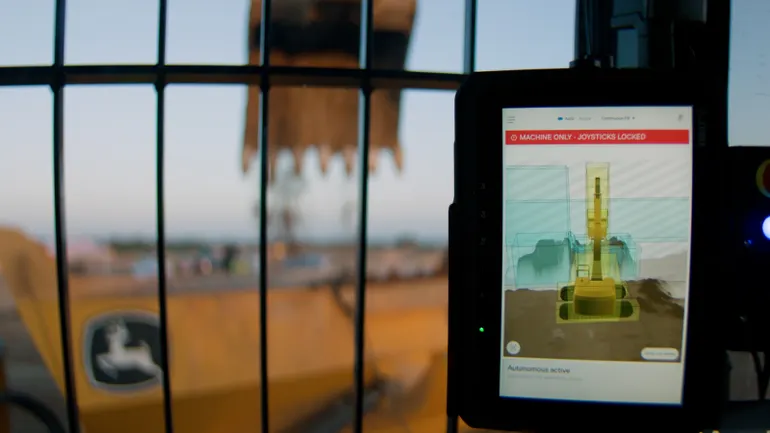
At multiple construction sites, excavator cabs are now empty.
Bedrock Robotics, a construction technology company headquartered in San Francisco, announced on Monday that it has deployedfully autonomous excavators。
at multiple critical infrastructure projects under construction across the United States. According to the company, these excavators use Bedrock's Operator system, which retrofits existing equipment with precision sensors and computing suites, enabling them to perform excavation tasks without an on-board operator. The system is currently in use at several key infrastructure projects, including a Nevada water treatment facility in partnership with Sundt Construction, and a 1.2 million cubic yard earthmoving project with Zachry Construction.
The announcement states that after a year of testing under human supervision, the technology has reached maturity for fully autonomous operation. Meanwhile, the momentum of robotics adoption in the construction industry is growing.
For example, on the same day Bedrock made its announcement, Switzerland-based Gravis Robotics revealed it had secured$200 million in Series A funding。
from SoftBank, the global technology investment giant. Bedrock's system can be installed in a single day. Once installed, the excavator can perceive its surroundings and autonomously execute complex tasks after site managers set the initial plan. The retrofitted excavators can work alongside other equipment under normal site conditions and will automatically shut down if they detect people or other objects too close.
"Our sensor suite and machine learning models are designed with safety as the primary principle and have been rigorously tested in both real-world and simulated environments," Bedrock Robotics CEO Boris Sofman told Construction Dive. "Our sensor layout provides the machine with a 360-degree view, eliminating the dangerous blind spots that human operators face. These machines operate autonomously only under approved conditions, and if the system detects any malfunction, it will pause operations and shut down."
Bedrock notes that excavator operation typically takes about five years to master, making it one of the most difficult pieces of equipment to consistently staff with skilled operators. For this reason, Bedrock has prioritized automation for excavators—which, according to the announcement, typically account for 25% of a contractor's equipment fleet.
"We are seeing more and more projects that require moving millions of cubic yards of earth," Sofman told Construction Dive. "As we expand into longer operating periods, such as nighttime, and automate more equipment that works alongside excavators, we will be able to directly compress project timelines, creating significant value for contractors and end clients."
From robotaxis to construction sites
Bedrock's co-founders and early core team members largely come from Waymo—the robotaxi company that currently offers autonomous ride-hailing services in11 cities across the United States, including San Francisco。
Although Waymo's technology has gained initial recognition—the Insurance Institute for Highway Safety found that Waymo vehicles have a lower crash rate than human-driven vehicles—it has not been without challenges. During San Francisco's July 4th celebration of America's 250th anniversary, dozens of Waymo vehicles causedmassive traffic jamsdue to an inability to navigate through traffic congestion.
Sofman told Construction Dive that such issues should be less likely in construction site environments.
"Bedrock's machines, depending on how customers use them, will be distributed across different sites nationwide," Sofman said. "This minimizes our exposure to such sudden peak events."
According to the announcement, Sofman expressed a vision to expand Bedrock's autonomous technology to other heavy equipment on construction sites, including haul trucks, bulldozers, and loaders.
"Excavators are just the starting point for Bedrock; the technology and infrastructure we build have been designed from the outset to go beyond a single machine type," Sofman told Construction Dive. "Ultimately, we will expand to other high-utilization, high-demand equipment."
In February of this year, Bedrock Robotics announced it had raised$270 millionto scale its autonomous construction technology. The company came out of stealth mode in July 2025, having previously secured$80 million in seed and Series A funding。