
NUCA Designates June as Trench Safety Month, Launches Annual Stop Work Training Campaign
NUCA designates June as Trench Safety Month and plans to hold its annual trench safety stop work event at hundreds of job sites nationwide from June 15 to 19, including safety training, educational seminars, toolbox talks, and on-site rescue demonstrations. Supported by OSHA and the Trench and Excavation Safety Task Force, the event aims to address trench collapses, one of the most persistent risks in the construction industry.
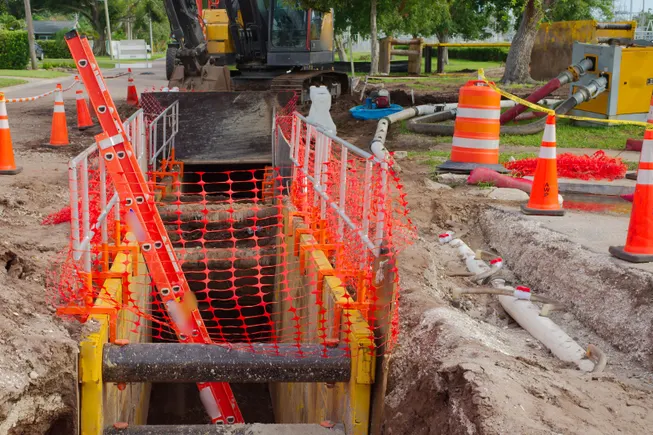
At a Glance
- The National Utility Contractors Association (NUCA) has designated June as Trench Safety Month and plans to hold its annual Trench Safety Stand Down at hundreds of job sites nationwide from June 15-19.
- Supported by the Occupational Safety and Health Administration (OSHA) and the Trench and Excavation Safety Task Force, the stand down will include safety training sessions, educational seminars, toolbox talks and live trench rescue demonstrations aimed at reinforcing safe excavation practices, according to a press release shared with Construction Dive.
- Trench incidents remain preventable through proper training, protective systems and adherence to excavation safety standards, NUCA officials said.
Deep Dive
There were 18 trench collapse fatalities in 2024, according to the latest data from the Bureau of Labor Statistics. In June 2025, OSHA said there had been 11 trench-related deaths so far that year. The deaths are not limited to the construction industry.
The June safety campaign builds on a decade of trench safety stand downs by NUCA and its member organizations to address one of the construction industry's most stubborn hazards. More than 24,200 workers and first responders participated in events at 461 job sites in 2025, according to a NUCA press release.
"When NUCA started Trench Safety Month, it was seen as a great way to introduce Trench Safety Stand Down Week to the entire underground excavation industry, not just NUCA members," Skout Raney, chair of NUCA's safety committee, told Construction Dive. "Dedicating an entire month to trench safety expands the concept of TSSD and, we believe, the reach of our safety message to more people who need to hear it."
Throughout June, NUCA plans to use social media, internal publications and industry media outreach to raise trench safety awareness. The association is also working with the Trench and Excavation Safety Task Force, a coalition of companies that have come together to raise trench safety awareness, to share information on training opportunities and excavation safety best practices.
Raney, who also serves as director of health and safety at AllClear Underground Solutions, a Florida-based underground water and sewer installation company, noted that interactive training has proven particularly effective.
"Scenario-based hazard recognition exercises are impactful because they present realistic situations, such as unstable soil, improper shoring or nearby traffic, and require workers to identify risks and choose the correct protective measures," he said.
The industry's challenge is not a lack of knowledge but maintaining consistent execution of proven safety practices, Raney said.
"Too often, schedule pressure, inadequate supervision or complacency lead crews to take dangerous shortcuts," he said. "Contractors must understand that awareness and training alone are not enough."
The focus on excavation safety comes as utility contractors continue to advance water, wastewater, broadband, electric and transportation projects funded by the Infrastructure Investment and Jobs Act. These projects are expected to require thousands of new workers, many of whom will need excavation safety training before entering the field.
Contractors should incorporate trench-specific safety instruction into onboarding programs, provide hands-on field training and empower competent persons to stop work when conditions are unsafe, according to Raney.
"No job is so urgent that it cannot be done safely," he said. "Every trench must be properly protected, inspected and treated as a potential life-threatening situation."