
Court Rules: Trump White House Ballroom Groundwork Suspended, Underground Construction Allowed to Continue
New developments have emerged in the legal dispute surrounding President Trump's White House ballroom construction project. On April 16, Senior U.S. District Judge Richard Leon, who is overseeing the case, revised the previous stop-work order, clarifying that only above-ground construction of the ballroom is suspended, while underground work involving national security upgrades may proceed. Previously, the U.S. Court of Appeals for the D.C. Circuit voted 2-1 to allow the work to temporarily continue and instructed Judge Leon to promptly clarify the relationship between the injunction and the security exception.
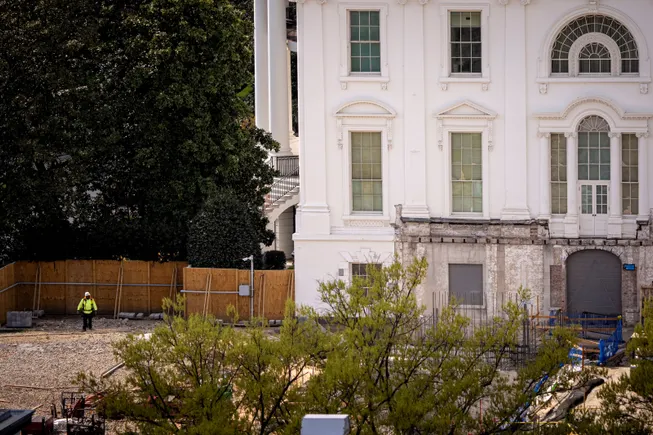
Update (April 16, 2026):The judge who halted construction of President Trump's White House ballroom hasrevised his order, clarifying the types of work that must stop.
After the stop-work order, the U.S. Court of Appeals for the D.C. Circuit urged Senior District Judge Richard Leon to re-examine the impact of the halt on national security. The White House stated that, beyond the ballroom, the underground work includes national security upgrades.
In response, Leon clarified his preliminary injunction, specifying that "underground construction may proceed, including any 'top-secret excavation, bunkers, bomb shelters, protective partitions, military installations, and hospital and medical facilities,' as well as above-ground construction strictly necessary to cover, reinforce, and protect these facilities."
He added a condition: underground work may continue provided it does not "lock in the above-ground footprint and massing of the ballroom."
Leon's revised ruling only pauses the above-ground work of the planned ballroom. His order also states that "national security is not a blank check to proceed with other unlawful activities."
Below is the original report.
A federal appeals court has temporarily allowed construction of President Trump's White House ballroom to continue.
In a 2-1 ruling on April 11, judges on the U.S. Court of Appeals for the D.C. Circuitallowed ballroom project work to continue at least through Friday. The court sent the case back to Senior District Judge Richard Leon, who on March 31ordered a halt。
Leon's ruling held that the president lacks authority to undertake major construction changes to the White House without congressional approval. The original stop-work deadline was 14 days, expiring this week.
The federal government's appeal argued primarily that construction must continue to ensure safety and security, including securing the site. The appeal also claimed the project includes "national security upgrades" in the underground work.
In response, the appeals court directed Leon to "promptly address the pending motions to clarify how the injunction and its exceptions will ensure the safety and security of the White House project."
In the ruling, Judges Patricia Millett and Bradley Garcia, appointed by former Presidents Barack Obama and Joe Biden respectively, urged further clarification on which aspects of the ballroom relate to national security and security, thus requiring construction to resume.
The ruling stated: "It is therefore unclear to what extent certain aspects of the proposed ballroom are necessary to ensure the safety and security of the underground national security upgrades, or to ensure the safety and security of the White House and its occupants while the appeal is pending."
Dissenting Judge Naomi Rao (Trump appointee) said the security vulnerabilities caused by the halt are "prolonged by the construction interruption," meaning the federal government's request for a stay should be granted and construction should continue.