
Study: Mass Timber May Inhibit Germs in Hospital Environments
A new study from the University of Oregon found that after brief wetting, the surface of mass timber materials had lower bacterial counts than control empty plastic boxes, suggesting a potential to inhibit germs, providing new evidence for the use of wood structures in medical settings such as hospitals.
News Summary
- According to a recent study by the University of Oregon, mass timber may have antimicrobial properties that make it promising for use in hospital construction.
- The research team found that after brief wetting, the abundance of bacteria on the wood surface was lower than in the empty plastic boxes used as controls.
- "People often think wood is unsanitary in healthcare settings," said Mark Fretz, the study's lead researcher, assistant professor and co-director of the Healthy Building Environments program at the University of Oregon. "But in reality, wood transmits microbes at a lower rate than other less porous materials like stainless steel."
In-Depth Analysis
According to the press release, these experiments were the first to explore the relationship between microbial communities on the surface of cross-laminated timber (a key component of mass timber) and volatile organic compound emissions under wet and dry conditions. Gwynne Mhuireach, a research assistant professor at the University of Oregon, stated this in the press release.
"We wanted to explore whether mass timber can withstand the daily rigors of healthcare environments," Mhuireach said in the press release. "In hospitals and clinics, germs are always present, and surfaces occasionally get wet."
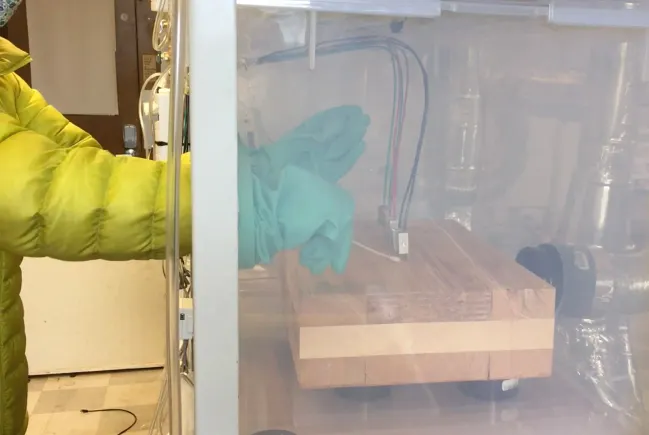
The study also included researchers from Portland State University in Portland, Oregon, and the Salk Institute for Biological Studies in San Diego. According to the press release, the research team sealed cross-laminated timber blocks in sterilized plastic boxes to create a controlled microenvironment of temperature and humidity. To simulate a healthcare setting, the air was filtered and exchanged at rates close to hospital standards.
The team sprayed tap water on the wood blocks under three scenarios: once, once daily for a week, and once daily for four weeks, and inoculated them with a mixture of microbes commonly found in hospitals. They used empty plastic boxes as controls and took samples regularly over four months. The press release stated that the study, supported by the USDA Wood Innovations Grant, showed that wood effectively inhibits bacteria and revealed clues about wetting treatments that will inform future research and development.
Additionally, the press release noted that, except for the first 14 days after inoculation, the abundance of live microbes in the empty plastic control boxes was higher than in the wood samples.
Wood releases terpene compounds, many of which have pleasant odors and can inhibit microbial growth. Fretz said that wood's ability to suppress pathogen transmission may also stem from its pores trapping bacteria, or from naturally occurring antimicrobial compounds in the wood.
Mhuireach also mentioned that volatile organic compound (VOC) emissions—chemicals that disperse quickly in the air and produce various odors—also leveled off after wetting, which the team interpreted as a slight rise relative to an overall downward trend.
Currently, mass timber has been used in a hospital construction project in Canada. According to a press release from Quinte Health (the hospital network to which PECMH belongs), the new Prince Edward County Memorial Hospital in Picton, Ontario, will become the first hospital in North America to use unencapsulated mass timber.
Fretz said that, aside from this case, exposed wood is rarely used in healthcare facilities, partly due to strict and slowly updated building codes, and partly due to widespread misconceptions about the relationship between wood and pathogens, which researchers hope to change.