
GSA accuses Congress of diverting its building maintenance fund
U.S. General Services Administration (GSA) Administrator Edward Foster testified before the Senate on May 13 that Congress has continuously diverted funds from the Federal Buildings Fund it manages since 2011, totaling $15.6 billion over 15 years ($22 billion adjusted for inflation), leaving nearly half of the agency's 1,600 properties in fair or poor condition. GSA is seeking congressional approval to fully use rental and sale proceeds and to raise the threshold for single-project approvals from $3.96 million to $75 million.
Since 2011, Congress has continuously siphoned funds from the building fund managed by the U.S. General Services Administration (GSA), the federal government's real estate management agency, to cover expenses for other federal departments. GSA Administrator Edward Forst disclosed this during congressional testimony on May 13. He stated that nearly half of the agency's 1,600 properties are currently in "fair" or "poor" condition.
"The GSA's maintenance backlog has surged by 408%," Forst told the Senate Appropriations Committee. He further noted that more than 1,300 buildings in the agency's portfolio require elevator replacements, HVAC system updates, fire safety upgrades, and electrical repairs.
Congress established the GSA's Federal Buildings Fund in the 1970s. The agency was authorized to collect rent and retain proceeds from property sales to maintain and upgrade its properties. However, as Forst stated, Congress has "hijacked" this fund—siphoning off $15.6 billion over the past 15 years, roughly $22 billion adjusted for inflation. According to some estimates, the resulting maintenance backlog has reached as high as $50 billion.
In its fiscal year 2027 budget request released in early April, the GSA asked Congress to allow it to fully use the rent and sale proceeds it collects. To emphasize this request, Forst sent a letter to Senate and House leaders on May 22, which was co-signed by 22 federal department heads, including Secretary of State Marco Rubio, Office of Management and Budget Director Russell Vought, and Treasury Secretary Scott Bessent.
Forst also pointed out two other ways Congress hinders the GSA's maintenance of federal properties:
Insufficient appropriations.Congress provides the GSA with only about half of the roughly $1.2 billion in budget authority the agency requests each year. "The funding shortfall accelerates the deterioration of our infrastructure," Forst said.
Per-project spending limits.Congress requires the agency to obtain congressional approval for any project exceeding $3.96 million in spending, and approval typically takes more than a year. "No private-sector real estate portfolio manager could operate successfully under these constraints," Forst said. He previously worked at Cushman & Wakefield, Bankers Trust, and Goldman Sachs.
The agency is calling on Congress to allow it to proceed without approval on projects costing up to $75 million, which would enable it to immediately start several projects in the pipeline. "This would allow the GSA to repair roofs before they fail, replace elevators before they trap people, and upgrade fire and life safety systems before lives are at risk," he said. "Market conditions have pushed basic maintenance costs well above the current threshold," Forst stated. "This leaves us in bureaucratic delays while buildings continue to deteriorate."
He noted that more than 125 properties under the agency's management are 100 years old or older. "Many are historic architectural gems that reflect America's democratic spirit and craftsmanship." However, the GSA lacks the funds needed to maintain these buildings. Forst emphasized that deferred maintenance only drives up future costs.
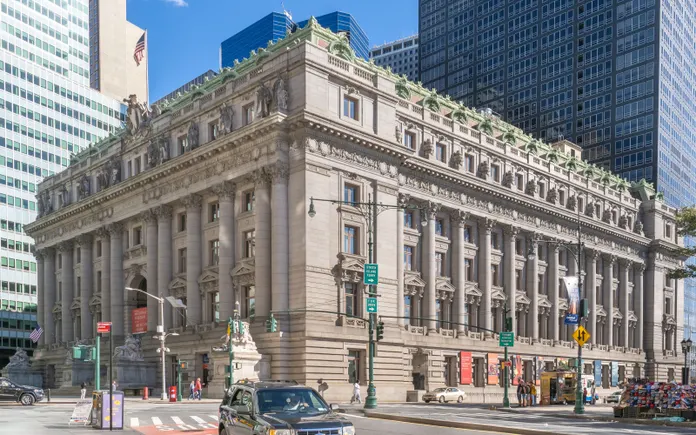
Take the Alexander Hamilton U.S. Custom House in New York City, for example. The building was completed in 1907 and needed $73.7 million in repairs a decade ago, but funding was not available at the time. Today, the repair cost has risen to $152.3 million—"a staggering increase of $78.6 million simply due to delay," he said.