
CORE Construction puts GNSS in the hands of field superintendents, and here's what changed
CORE Construction puts Emlid centimeter-level GNSS receivers directly into the hands of field superintendents and project engineers for immediate self-checks on critical steps. Before one concrete pour, a superintendent found all anchor bolts offset by about 6 inches, and timely correction saved significant costs. This tool serves as an internal verification method, compensating for the limitations of drone aerial surveys in detail validation and reducing temporary reliance on external surveyors. The company is currently beta-testing across three regions, with plans to establish a standardized deployment framework by summer 2026.
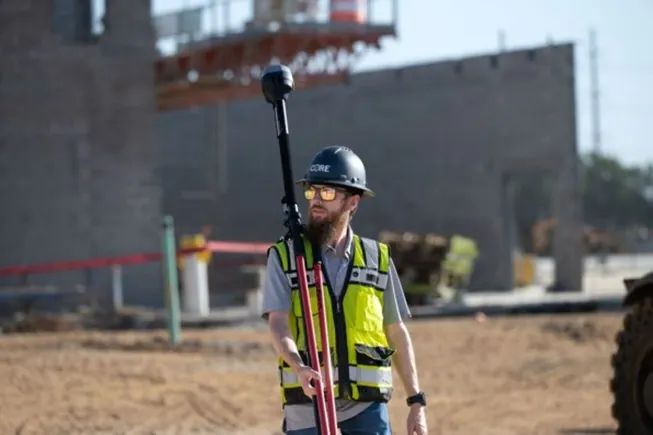
Shortly before a concrete pour, Colby Lindsay was checking anchor bolts on site when he found that every single bolt was off by about 6 inches. Catching the mistake before the concrete was poured and steel arrived saved the company a significant amount of money.
"That alone paid for the equipment," Lindsay said, "and maybe even 10 of them." Lindsay is the virtual construction manager and BIM coordinator at CORE Construction. Recently, the company began handing centimeter-accurate Emlid GNSS receivers directly to field superintendents and project engineers. Their idea: let the field team closest to the construction check things themselves while there's still time to fix mistakes.
A company built around quality control
CORE Construction is a general contractor managing K-12 schools, healthcare, and municipal projects across California, Nevada, Arizona, Idaho, Texas, Indiana, Illinois, and Florida. Since a large portion of its portfolio involves complex renovations of existing campuses, precision is critical.
Danielle Williams, director of the virtual construction department, is responsible for driving field technology adoption. Her team identifies worthwhile problems through site visits. "We see the issues the field teams face, the quality control pain points they encounter most often, and that's where we look for new technology," Williams said of the field teams.
To manage quality, CORE Construction uses the U.S. Army Corps of Engineers' three-step approach: pre-construction meetings with subcontractors, first-article inspections, and ongoing follow-up inspections. The new GNSS receivers support these initial and subsequent checks.
The data gap drones can't fill
Although the team has used drones for years to map site terrain via ground control points, aerial imagery falls short on detail. From 100 feet up, a drone can't verify a 1-inch anchor bolt or ensure a pipe sleeve lands precisely within a wall.
"When you need to verify anchor bolts for steel column connections, those are 1-inch bolts," Williams said. "From 100 feet up, you can't get that close." Pipe sleeves have to land within walls, which also can't be confirmed from the air.
That leaves a common gap: a drone can tell the team something looks roughly fine from above, but it can't confirm the details. When those discrepancies aren't caught until steel arrives, schedules slip and rework costs pile up.
Before adopting GNSS, CORE Construction's only options for detailed verification were relying on unreliable manual measurements or paying for a licensed surveyor to make an unscheduled visit.
Inspections before the surveyor arrives
CORE keeps licensed surveyors on every project, but the cost of out-of-scope, unscheduled callouts adds up quickly. Bringing full surveying in-house isn't practical due to licensing requirements.
Instead, the company found a middle ground: using Emlid Reach receivers with RTK (real-time kinematic) corrections to lock centimeter-level accuracy right on site. Now, field superintendents can verify layout results on the spot.
"It's a great aid to determine whether there's a problem, and then we can bring in the surveyor," Williams said. "It's kind of that step in between."
CORE Construction doesn't build based on GNSS receiver data or treat it as a formal survey. It serves as an internal check that shifts field conversations from "we think there might be a problem" to "we know there's a problem."
Sharper questions, faster answers
Verification is only half the value. The technology has also changed how CORE Construction interacts with subcontractors.
By importing survey data and subcontractor drawings into the Emlid Flow field app, the office, field, and subcontractors are all looking at the same georeferenced map. When a superintendent who understands the data approaches a partner, conversations get shorter.
"A lot of times I ask a more targeted question and get the answer I need right away," Lindsay said, "instead of them dragging it out for months like before."
That's the part a general contractor feels across every trade on site. A sharper question, backed by data everyone can see, ends back-and-forth that used to drag on for weeks. Subcontractors spend less time troubleshooting and more time building.
Putting GNSS in the field team's hands
Lindsay personally picks the people he thinks will benefit most from the receivers—usually field superintendents who already feel the pain—and delivers the units himself. Often, he'll help them use it once. That's usually enough.
The company is currently using multiple Reach RS3, RS4, and RS4 Pro receivers, intentionally treating this phase as a beta test, gathering different feedback across three regions. In Texas, the users are mainly field superintendents and assistant superintendents. A team in Arizona is using GNSS for off-site road work that would normally require a total station. A team in Reno is combining it with commissioning work.
Data flows smoothly between platforms. CORE Construction transfers DXF files between Emlid and DroneDeploy. Recently, they imported DroneDeploy imagery as a map layer into Emlid Flow, so the same drone-captured wide view sits beneath centimeter-level checks. Since projects sync through the Emlid Flow 360 cloud platform, a point collected by a field superintendent on site reaches the office without emailing files.
Scaling up: from field beta to standard operating procedure
By summer 2026, Williams plans to analyze the beta data to build a standardized framework for company-wide GNSS deployment.
This is part of a larger trend in construction technology: moving precise data from the back office directly to the field. By putting these tools directly in the hands of field superintendents, general contractors can catch costly mistakes early without slowing down the schedule.
For CORE Construction, the days of guessing or waiting for an outside surveyor are over. Field superintendents can now spot issues, complete checks in minutes, and move forward with data-driven confidence. Catching major errors before concrete is poured is no longer just good luck—it's part of the daily workflow.