
Kiewit executive: Nuclear power construction business expected to exceed $1 billion in annual revenue
In an interview with Construction Dive, Mike Rinehart, president of Kiewit Nuclear Solutions, revealed that the company's nuclear revenue has doubled annually since 2022, with over 10 commercial nuclear projects and 12 Department of Energy projects under construction. He believes that electricity demand from tech companies and the federal government is driving a nuclear renaissance, and the company's nuclear business is expected to exceed $1 billion annually.
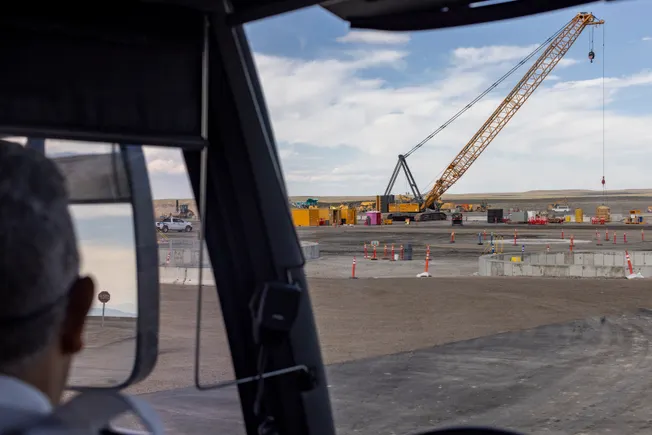
Kiewit expects its nuclear power construction business to accelerate into a business generating $1 billion in annual revenue.
The general contractor, headquartered in Omaha, Nebraska, has seen its nuclear revenue roughly double each year since 2022. Mike Rinehart, president of Kiewit Nuclear Solutions, told Construction Dive that the company currently has more than 10 commercial nuclear projects under construction, with another 12 projects under the U.S. Department of Energy (DOE).
Growth is driven by nearly insatiable demand for electricity from tech companies and the federal government.
For example, according to a June 23 announcement, the DOE is offering up to $17.5 billion in loans to support utilities and other energy companies in developing 10 nuclear reactors at five sites. Earlier this year, the U.S. Nuclear Regulatory Commission (NRC) issued the first commercial nuclear reactor construction permit in nearly a decade to a subsidiary of TerraPower, a nuclear reactor design and development firm backed by Bill Gates.
Rinehart sees an opportunity to seize this momentum.
Here, Rinehart discusses with Construction Dive the resurgence of nuclear power construction, project execution, and workforce and supply chain challenges.
Editor's note: The following has been edited for brevity and clarity.
Construction Dive: What is driving the interest in nuclear power construction?
Mike Rinehart:Our observation of the nuclear market is that it has clearly gained a lot of momentum, and there is significantly increased interest. Today, it remains the only zero-carbon power generation resource that can meet demand at scale.
Kiewit believes that for us, the nuclear business can easily reach $1 billion a year or more. That's the scale we see.
It all ties to overall electrification demand, and AI and data centers are obviously big consumers. But even before the hyperscale data center boom, we were already seeing interest and growth in nuclear.
At that time, it was even just general electrification, like electric vehicles. More importantly, the existing operating generation assets in the U.S. are aging, and many large coal and other fossil fuel generation assets are nearing the end of their useful life.
A lot of renewables, while valuable, may not necessarily fill all the base load generation at scale.
Where are the biggest opportunities in nuclear construction right now?
It wouldn't be fair to pick just one—small modular reactor projects, large reactors, DOE work, I think they all have their place.
To use a rough analogy, nuclear power is like cars. Not all cars are the same. Large semi-trucks have a specific purpose, and sports cars and race cars have very specific purposes. I can make the same argument for the various nuclear technologies that exist today.
Large reactors have a strong place in our generation grid, SMRs also have a place, and even microreactors have their strategic uses.
It really depends on what the demand is and finding the right technology for that application.
What are the biggest challenges these projects face?
I think the construction challenges in most nuclear projects stem more from the overall organization of the project, that is, whether it can follow what we call the EPC (engineering, procurement, construction) execution manual.
It's easy to say the regulatory environment is more complex and burdensome, and you have to go through NRC reviews, which certainly has some challenges. But I think some people use regulation as a scapegoat for nuclear project failures.
These projects are large and very complex, and even smaller projects are still large, complex projects.
Along with that comes what is called 'first-of-a-kind' technology. While there are nuances and challenges with first-of-a-kind technology and its engineering and regulatory processes, this is not entirely without precedent in other industries and markets.
I think the biggest challenge for some large projects is how to properly integrate engineering, procurement, and construction with all stakeholders in the project.
These stakeholders may include regulators, local authorities, and utilities.
Achieving full integration and truly seamless project management to manage risk, quantify risk, and accurately report project progress is the bigger challenge facing the industry today.
How concerning is the workforce for these projects?
You see everyone talking about labor shortages on LinkedIn, but the building trades unions always manage to get through.
We have a regular building trades union working group, and I'm a member on the nuclear market side. We communicate quarterly with all the building trades at the national level. So, the building trades are certainly under a lot of pressure to support all this work. At the same time, I think if you have a good plan and ensure there are the right tools, support, and employee benefits, skilled labor will show up.
What equipment and material constraints are you most concerned about?
The nuclear industry has stricter quality standards for safety-related components, especially those within the scope of NQA-1 (the national consensus standard for quality assurance in the nuclear industry).
The conventional supply chain is already under stress from basic commodities like steel, piping, or electrical equipment, and electrical equipment is currently a big issue. Transformers, switchgear, and the like are very hard to get.
But the NQA-1 supply chain for safety-related components, which are typically in the nuclear island and reactor, this market will not be able to support the demand we see.
So, many of our tier-one EPC companies are planning to have their own commercial grade item dedication capabilities, which means using commercially sourced like materials but with additional engineering, laboratory testing, and a lot of oversight to ensure quality.
I think for the market to move in the direction we want, being able to support this on our own will be absolutely necessary.
