
Contractors caught between vaccine hesitancy and owner mandates
As the Delta variant drives a surge in COVID-19 cases in the U.S., the construction industry, after a brief recovery, is tightening pandemic measures again. Owners have begun mandating vaccinations for site workers, but vaccine hesitancy within the industry remains high, putting contractors under multiple pressures from labor shortages, on-site verification, and legal liabilities.
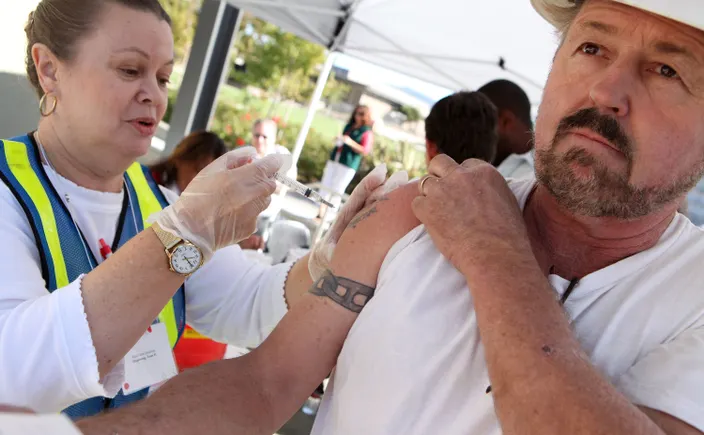
The construction industry was supposed to be back to normal by now. In June, with vaccines widely available in the U.S. and COVID-19 cases plummeting, many saw Labor Day as the moment when employees would return to offices and the pandemic would fade from memory. However, reality has not lived up to expectations.
"We started reopening in June, full of hope," said Laura Guzman, Vice President of Marketing and Communications at XL Construction in Milpitas, California. "But as we watched the latest trends, we had to hit the pause button again." She mentioned measures including complying with local mask mandates, maintaining social distancing on job sites, and limiting company meetings and gatherings.

XL is not alone. Other construction professionals who thought they could move forward with projects unhindered by the virus are now having to re-implement many of the pandemic protocols they relaxed earlier this year. They say new COVID-19 challenges have emerged as the industry enters its second fall of the pandemic.

"Contractors we work with are redoubling their efforts to ensure workers in offices and on job sites are following local and federal regulations," said Brian A. Wolf, a partner at the Fort Lauderdale, Florida construction law firm Smith, Currie & Hancock. "They take the health and safety of their employees and the public very seriously."
Rising Case Numbers
Driven by the highly contagious Delta variant and breakthrough infections among the fully vaccinated, COVID-19 cases are surging again, with the national daily new infection count recently reaching 100,000, a level not seen since February. Medical professionals predict the number could reach200,000 caseswithin weeks. After analyzing preliminary data from six states,The New York Timesrecently reported that breakthrough infections account for 18% to 28% of all new infections.
Josh Stark, Senior Vice President of Construction at Focus, a Chicago-based developer and contractor, said the broader impact of the current surge could further hinder the construction industry, especially as material suppliers have just been restoring capacity.

"We're seeing suppliers come back online, which is good. But if COVID hits hard again, will these companies have to shut down?" Stark said. "That affects our industry from a supply standpoint, so it's definitely a concern."
The surge coincides with the reinstatement of mask mandates in many places, while many large employers, including the federal government, the U.S. military, United Airlines, Walmart, and Disney, have announced they will require employees to be vaccinated to return to work.
For the construction industry, these issues are occurring against a backdrop of persistentlyhigh vaccine hesitancy—more than 40% of workers have consistently said they would not get vaccinated even if given the chance. Now, this hesitancy is colliding head-on with theconcernsof vaccinated workers, and with mandates from project owners increasingly requiring vaccinated-only workers on job sites.
According to CPWR (the Center for Construction Research and Training), a nonprofit focused on construction safety based in Silver Spring, Maryland, vaccination rates in the construction industry have been lower than in other occupations, while vaccine hesitancy has been relatively high.
"In recent weeks, we've started receiving vaccine mandates from owners for job sites," said Kyle Peacock, CEO of Peacock Construction in San Francisco, noting that about 75% of his direct employees are vaccinated, but subcontractors have lower rates. "All our healthcare clients are doing this, but we've also had a few office tenants say they will only allow vaccinated people into their offices. This is something we're trying to figure out."
A major concern for contractors now is that the construction industry's long-standing labor shortage, already exacerbated by the pandemic, could worsen as clients require vaccinated workers on job sites.
Take, for example, a recent letter to members from the Inland Northwest Chapter of the Associated General Contractors of America (covering eastern Washington), sent after Democratic Governor Jay Inslee ordered most state employees to be vaccinated by October 18.
"It must be noted that this mandate applies to all employees, contractors, subcontractors, and suppliers who work on or enter state job sites," wrote Cheryl Stewart, the chapter's executive director. "I know many of you will have employees who choose not to participate in state projects given the vaccine requirement. It's also certain that state agencies will lose employees as a result, so project delays everywhere will become the norm."
Indeed, Ken Simonson, chief economist at AGC, citing data showing construction employment levels in 36 states remain below pre-pandemic peaks, said Delta could send shockwaves through the industry.
"The rapidly spreading Delta variant of COVID-19 could make it harder to find qualified workers willing to work on restricted job sites, and could also dampen demand as some owners delay projects," Simonson said in astatementregarding July employment data.
Tracking and Management
Beyond the impact on the number of available workers on vaccinated job sites, contractors facing client mandates also confront the challenge of how to implement such requirements.

"How do you monitor it? Do you check vaccination cards at the gate?" Peacock said. "If it's just our own employees, it's relatively easy, but we have hundreds of subcontractors coming to the site every day, plus supplier deliveries."
One solution Peacock and others have adopted is Safe Site Check In, a job site screening app workers have been using during the pandemic, which can be customized to ask workers about their vaccination status. Landmark Builders, a commercial contractor in San Jose, California, has adopted this approach.
"We've set it up now to basically ask just two questions: 'Are you vaccinated?' with a yes or no option, or 'I choose not to answer,'" said Sheri Dizon, CFO of Landmark, noting that all employees in the company's office are vaccinated. "But on job sites, it's very different."
The company has been tracking vaccination status responses through the app and found a 60% vaccination rate and 40% non-vaccination rate among its subcontractors, a ratio closely matching construction worker vaccination surveys. "It's a political debate you can't win," Dizon said. "But if they're not vaccinated, they'll tell you."
Landmark's clients also require fully vaccinated workers on job sites. But in one case, a popular supervisor who was not vaccinated was allowed by the client to remain on the project. "They like him, so they said he's fine," Dizon said.
Contractors like XL and Peacock say they have not yet issued company-wide vaccine mandates, but they haven't ruled out the possibility in the future. Instead, they have rolled out programs encouraging workers to get vaccinated and providing education to help workers make decisions. "We brought in medical experts to explain the safety elements and answer questions," said XL's Guzman. "We've made a tremendous educational effort to get as many people as possible to make this choice for themselves."
Peacock said that although lawyers have told him hecan mandate vaccines for workers, there are still issues that have prevented him from doing so. "We're having internal conversations, but while everyone says it's legally feasible, there isn't much case law on it," Peacock said. "There's still some liability risk."