
Apartment developers accelerate adoption of modular construction
Modular construction is emerging as a new trend in U.S. multifamily housing development. According to the 2022 Modular Building Institute report, multifamily housing accounts for approximately 23% of commercial modular output, yet overall penetration is only 5.52%. Developers value its advantages such as shortened construction timelines and the ability to build in winter, but costs are not lower than traditional methods. Variations in transportation regulations, requirements for design standardization, and a shortage of skilled labor remain core variables facing the industry.
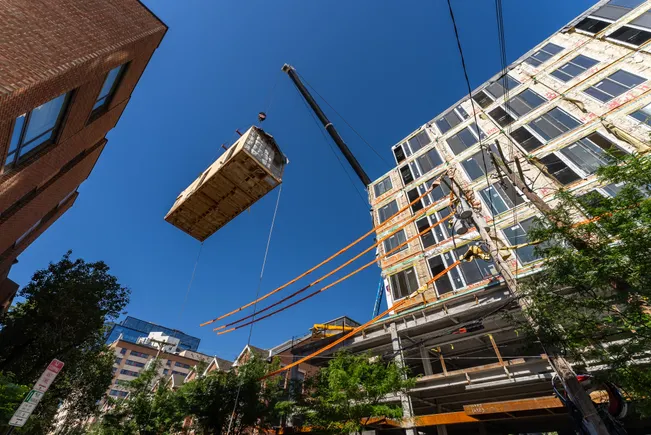
More and more multifamily housing projects are beginning to adopt offsite construction methods. According tothe 2022 Modular Building Institute (MBI) report, developers are leveraging the faster construction timelines of this technology to drive continued expansion in this segment.
The multifamily housing market remains the fastest-growing sector in the modular construction industry. The MBI report shows that last year this sector accounted for approximately 23% of commercial modular output.
This higher adoption rate contrasts with the overall trend in modular construction, which has a penetration rate of only 5.52% across all building types. From a multifamily perspective, keeping modular design simple—using a single design for each unit type, nesting smaller pods within larger ones, and adopting standardized building layouts—is crucial to its success.
Developers also favor offsite construction techniques because projects can proceed almost uninterrupted during the winter months, something that is not possible with on-site construction in most parts of the United States, said Anirban Basu, chief economist at the Associated Builders and Contractors.
Speed to market is also one of the main advantages of modular projects, said Derrick Seitz, senior project manager and modular expert at Windover, a construction company based in Beverly, Massachusetts. The company provides modular solutions for multifamily housing to its clients.

Contractors also say modular construction brings environmental and safety benefits. For example, it reduces construction waste and eliminates the risk of falls from heights on site—the leading cause of death in the construction industry.
Saving Time, Not Cost
Although contractors and developers see many advantages in modular apartment buildings, a lower price is not one of them.
"At the outset of our engagement with clients considering modular, we always make it clear: the construction cost is the same as traditional methods," Seitz said. "Modular allows you to deliver the product earlier than traditional methods... That is usually its selling point."

Ernesto Lopes, CEO and president of Resia, a Miami-based developer, also believes that fast delivery is the main appeal driving modular adoption in the apartment sector. Resia uses prefabrication technology to buildaffordable new housingin South Florida, Atlanta, and Texas, without relying on government subsidies.
"Time is very important in our financial equation," Lopes said. "Our pods are actually more expensive than on-site construction, but on average they save us two and a half months of construction time. That is significant, and for us it makes sense financially."

Lopes said using prefabricated pods currently costs about 3% to 5% more than traditional construction, but he expects this cost to decrease as new factories come online. These pods are fully fitted out in the factory with bathrooms, mechanical, electrical, and plumbing (MEP) systems, and are then transported to the site for assembly. The pods consist of prefabricated bathrooms, kitchens, and utility rooms.
Resia plans to build a 200,000-square-foot pod manufacturing plant in Panama City Beach, Florida, capable of producing about 20,000 pods per year, Lopes said. He expects the plant to be operational in 2024 and aims to deliver 8,000 new apartments annually in the Sun Belt by 2025.
Greystar, the largest multifamily housing developer in the United States, also plans to open anoffsite manufacturing plantin Knox, Pennsylvania. Greystar's wholly owned subsidiary, Modern Living Solutions, purchased this 256,000-square-foot industrial facility in 2020 to prefabricatemodular bathrooms。
Even the Biden administration ispromoting modular constructionas part of its efforts to close the housing supply gap within five years. The plan provides funding for affordable housing production and increases federal financing options for such projects.
Overcoming Obstacles
However, traditional contractors reportvarious obstaclesto offsite construction techniques. These include: new modular-specific processes that may bypass existing trade partnerships, on-site errors that erode expected cost savings, and high transportation costs.
However, construction firms specializing in modular construction have found ways to address these challenges.
Windover's multifamily division accounts for about 60% of its annual business portfolio, with about 15% of that being modular projects, Seitz said. The company has developed databases and matrices to show subcontractors the work that needs to be done after modular boxes are installed. Windover does not operate its own factory but partners with multiple modular manufacturers.
"There is definitely a learning curve," Seitz said. "Windover has invested over the years in educating ourselves on how to skillfully set expectations for our trade partners."

Seitz added that being involved from the design phase of a project also helps, allowing MEP systems to be designed in a way that is more suitable for modular installation.
"Most of our volumetric modular construction comes from New England or northern Canada," Seitz said. "The farther the factory is from the project site, the more the economics start to decline due to transportation and logistics costs."
Transportation Challenges
This is largely due to differences in state transportation regulations, said Dafna Kaplan, founder and CEO of Cassette, a Los Angeles-based modular construction company focused on multifamily housing and hotels. For example, in California, any trailer wider than 15 feet requires a police escort, while requirements in other neighboring states may exceed 20 feet.
"You have to consider where the volumetric modules are manufactured and where they are going; it is an important part of evaluating the project economics," Kaplan said. "It is also one of the reasons modular projects are difficult to bid hard, because they are not homogeneous and comparable."
Cassette's approach is to strip this complexity out of the project by offering a fixed-price product that includes installation at each location it serves, Kaplan said. In other words, Cassette handles supply chain strategy, logistics, and just-in-time delivery, thereby "allowing the general contractor to not have to become a logistics expert to be successful," she said.
Lopes, on the other hand, avoids transportation challenges by shipping prefabricated pods, such as bathrooms, kitchens, and utility rooms. These pods are transported on tractor-trailers and do not require much storage space once they arrive on site.
Design Limitations
To this end, the core of Resia's buildings is completely identical. Its one-bedroom, two-bedroom, and three-bedroom apartment layouts are exactly the same across all its developments.
"If a developer has three or four different unit types, modular construction becomes very inefficient," Lopes said. "I do not think modular construction can efficiently replace traditional construction. It is only efficient when the product is standardized and the smaller pods, manufactured offsite, can be installed immediately on site. This makes sense for us, but I am not sure it applies to other companies."
Kaplan also believes that, at least in the early stages of adoption, a single product approach remains the best path for modular builders.
"If we are going to move to a manufacturing process and disrupt the way construction is done, trying to do it with 16 different products, while also educating the subcontractor community and general contractors, would be too heavy a burden," Kaplan said. "Therefore, we believe our approach—streamlining to a single product—is because the industry first needs to learn this process, and each of our subsequent products will follow a similar process."
As more builders increase their modular adoption, this should open the door to more design flexibility, she added.
"If enough clients invest in buying Cassette's designed one-bedroom product, we will certainly launch the next product, and the next one after that," Kaplan said. "That is our expectation."
However, the distance from factory to site is only part of the mechanism determining total cost, said Vaughan Buckley, CEO of Volumetric Building Cos., a modular construction company based in Philadelphia. He added that the ultimate determining factor is more nuanced.
"Whether modular construction is viable on a particular site is a relatively simple equation involving two variables: how high are labor costs in the market where the building is located, and how available is the labor force," Buckley said. "The answers to these two questions will determine the maximum distance modules can be transported and whether the project is feasible."

Labor Shortage Accelerates Modular Adoption
Experts say the labor shortage—the number one challenge facing most contractors—should continue to drive interest in modular construction.
Tom Hardiman, executive director of MBI, said that according to the MBI report, modular's market share is expected to grow from 5.52% in 2021 to 10% over the next five years.
"We do expect volumetric modular and offsite construction to increase because the number of skilled tradespeople on site is decreasing," Seitz said. "Although factories also face the issue of fewer skilled tradespeople, they are slightly more successful in recruiting and retaining skilled workers because the work environment is controlled and air-conditioned."
Lopes also believes that the widespread labor shortage is increasing construction companies' interest in modular construction.
"There is a ticking time bomb in skilled labor. We do not have immigration policies, and without policies, you cannot replenish those tradespeople," Lopes said. "Skilled labor is becoming harder to find, and it is going to get worse. We see this as the biggest threat to our growth."