
Manufacturing construction boom not over: why contractors are still going all in
After hitting a record high in May 2023, the manufacturing construction boom has shown signs of cooling, but most contractors say they have not felt a downturn and instead expect activity to accelerate in 2024. Companies such as PCL, JE Dunn, and Clayco all have substantial backlogs and benefit from funding from the Inflation Reduction Act and the CHIPS Act. However, challenges such as labor shortages and long equipment procurement lead times remain, which could impact project schedules.
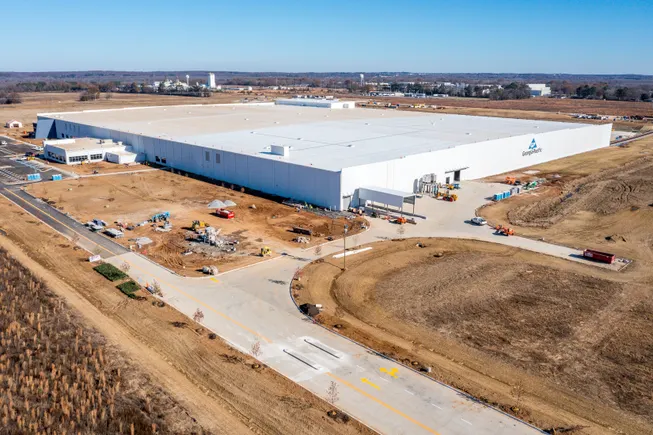
Since reaching an all-time high in May 2023, the manufacturing construction boom has shown signs of fading. Although current manufacturing construction activity remains well above pre-2022 levels, according to Dodge Construction Network, starts in the sector have begun to slow. This has also raised questions from The Wall Street Journal aboutwhether the sector has entered a downturn.
However, despite these signals potentially indicating future weakness, most contractors remain optimistic.
"The manufacturing construction sector is very busy, and based on communications with clients, we do not expect a slowdown in the near term," said Andrew Ahrendt, national director of manufacturing at PCL Construction. PCL is headquartered in Edmonton, Alberta, with its U.S. headquarters in Denver. "We are just scratching the surface."
Manufacturing construction activity shows signs of slowing
General contractors in the sector insist they are not feeling a downturn. In fact, they still expect activity to accelerate in the near term.
For example, in addition to PCL, JE Dunn plans to continue taking on manufacturing projects in 2024. The Kansas City, Missouri-based company will deliver Dongwha Electrolyte's first project in North America—a$70 million electric vehicle battery production facilityin Clarksville, Tennessee, as well as a$425 million manufacturing plant。
for Georgia-Pacific's Dixie brand consumer products. "We see continued demand in the market for large capital projects, and our construction and engineering peers are also busy handling new project inquiries," said Brent Strength, JE Dunn's senior vice president and manufacturing market leader. "Manufacturing construction in 2024 should exceed 2023. Contractors have healthy backlogs accumulated in previous years, and funds from the Inflation Reduction Act, the CHIPS Act, and others are currently being heavily deployed."
Chicago-based Clayco also expects to remain busy with advanced manufacturing construction this year. The company recently won contracts to buildRivian's $5 billion electric vehicle plant in Stanton Springs, GeorgiaandEntek's $1.5 billion manufacturing campus in Terre Haute, Indiana.

"I do believe the advanced manufacturing sector is continuing to receive significant investment, and I think that investment will continue to expand at a very high rate in 2024," said Anthony Johnson, president of Clayco's industrial business unit. Clayco is a Chicago-based construction company. "We will see more capital projects added in 2024 than we did last year."
2023 issues persist
Despite the optimistic outlook, contractors working on manufacturing construction also face specific challenges.
Strong manufacturing starts in 2023 have lengthenedlead times for many materials, especially microchips, HVAC equipment, electrical switchgear, and custom millwork. Additionally, countries in Asia and elsewhere produce many of the critical materials needed for electric vehicle battery technology, such as copper and nickel, Strength said.
This can slow progress because integrating this equipment into U.S. building codes and standards requires a unique team with design-build capabilities. Procurement issues, as well as compliance with U.S. electric vehicle building codes—especially for first-time builders—can add months to the overall project lifecycle, Strength said.

"Lead times for critical equipment remain something we spend a lot of effort mitigating," Strength said. "Speed to market remains a priority. Working with companies that understand how to plan ahead and address these challenges is crucial."
Nevertheless, the slowdown in interest rate hikes, easing inflation, and stronger consumer confidence should help boost activity in 2024, Johnson said. He added that despite some remaining uncertainty, the U.S. is in a more controlled state regarding inflation and interest rate hikes this year.
"I think all these factors are converging to provide some tailwinds for the industry," Johnson said.
Manufacturing construction activity to accelerate again this year
Labor challenges
In 2023, buildersconstructed many phase-one projects. This year, Johnson expects a similar second wave of related projects to break ground.
Additionally, for companies that experienced delays in planning, financing, or procurement agreements in 2023, those projects are likely to break ground this year as well. For example, 16 manufacturing projects (totaling approximately $8 billion) had their target start dates pushed from late 2023 into 2024, said Richard Branch, chief economist at Dodge Construction Network.
This will exacerbate a long-standing challenge within the industry.
"In 2023, skilled labor across the U.S. was truly under pressure," Johnson said. "This year, it will only intensify because you have the wave of projects similar to 2023, and now a whole new wave of projects starting in 2024."
Notable projects delayed last year include Scout Motors' $2 billion plant in Blythewood, South Carolina, andAmerican Battery Factory's $1.2 billion plant in Tucson, Arizona。
. "I think there is some risk here, particularly labor availability issues could undermine this forecast," Branch said. "And at the same time, electric vehicle demand also seems to be slowing."
TSMC recently delayed the production schedule for its second plantfrom 2026 to 2027 or 2028, due to a shortage of skilled workers and challenges in securing U.S. government funding, Chairman Liu Te-Yin said. The company had previously delayed production at its first plant from 2024 to 2025.

Nevertheless, many projects funded by Inflation Reduction Act tax credits are already in design, and with supply chains already shifting to rely on these new models, these projects are likely to move forward, Ahrendt said. This momentum will keep general contractors in the sector busy for a considerable period, Strength said.
"The pace and scale of capital investment may fluctuate," Strength said. "But we believe the momentum will continue to move in a positive direction in the coming years."