
AI Integration Empowers Construction Sites: Industry Transformation Amid the Data Center Construction Wave
As the demand for data center construction surges, the construction industry faces the dual challenges of a skilled worker shortage and resistance to AI applications. This article analyzes the reasons behind worker resistance and proposes leveraging leadership guidance, a safe learning environment, and practical AI tool applications to drive the industry's transformation from traditional manual methods to digital collaboration, addressing future construction pressures.
Viyas Sundaram is the CEO of STACK Construction Technologies, a construction estimating software provider headquartered in Cincinnati. The views expressed in this article are solely those of the author.
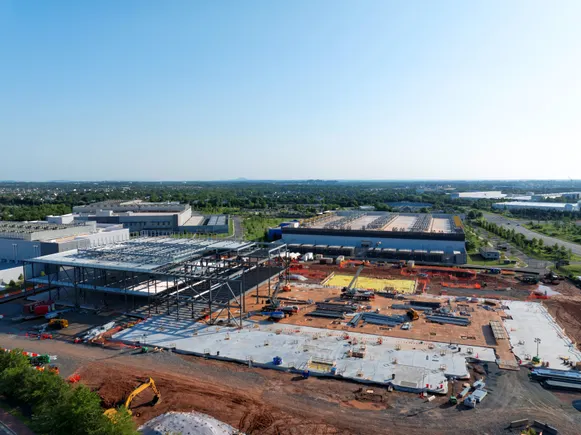
In recent months, data center projects have drawn widespread attention, with ambitious plans for hundreds of buildings across the country. For construction workers, this investment boom presents both opportunities and challenges.
On one hand, the urgent demand for construction projects has directly driven the emergence of high wages, bonuses, paid leave, and stable jobs. Against the backdrop of high mortgage rates and weak housing demand, residential construction has cooled significantly, making data center projects a lifeline for the industry.
Data center projects not only offer higher pay but also more overtime opportunities, attracting both entry-level workers and seasoned professionals.
However, as data center demand continues to rise, the existing pool of skilled workers is insufficient to meet such a massive scale of construction.

Ironically, veteran workers who have spent decades on construction sites often resist integrating artificial intelligence into their workflows—even though AI could accelerate manual tasks, reduce overtime, and improve accuracy in pre-construction estimating and quantity takeoffs. Currently, much of the work still relies on pen and paper, leading to extended hours and inefficiency.
According to the Financial Times, about 40% of data centers originally scheduled for completion in 2026 are expected to face construction delays.
Humans are not designed to handle such sustained pressure, yet the industry resists digital tools that could accelerate work. So, what should the next step be?
Where does the resistance come from
According to the Wall Street Journal, over the past year, more than half of data center constructions were interrupted due to skilled labor shortages. Integrating existing technology into workflows could have alleviated these issues or at least reduced their frequency, but workers often prefer proven and familiar methods, especially when timelines are tight and the cost of mistakes is high.
However, AI is no longer just a tool for "techies"—it is becoming a foundational transformation for the industry, much like the internet once was. Regardless of the industry, learning to use AI is no longer optional. In the face of profit and productivity, rejecting this technology means falling behind peers who are willing to adapt, which carries significant risk.
How to drive the change
This change begins with leadership. Leaders need to play a greater role in communicating the benefits of AI integration and take measures to familiarize workers with new procedures. Field personnel should master the operations before a project begins, rather than learning hastily during construction.
These workers are skilled and diligent, and their years of professional reputation should not be underestimated. Acknowledging that the construction industry is changing poses a challenge to their pride—after all, they have long been accustomed to how the industry operates. Yet, it is precisely their on-site experience that makes them better suited than anyone to evaluate and deploy these tools.
Creating a safe learning environment for workers to experience the seamlessness and ease of the technology firsthand will be key to driving adoption.
AI's potential in construction
Construction workers have always been the closest to the job site, and this proximity makes them the most valuable users of AI tools. With AI-integrated software, workers can cross-validate designs against real-world constraints before driving a single nail or laying a single brick.
Take a practical example: when reviewing data center drawings, a contractor can identify early on that the mechanical room's area does not match cooling requirements, thereby avoiding costly change orders. This is not just an efficiency gain; it is a shift in project knowledge.
In the next five years, construction workers will no longer merely execute drawings but will combine decades of on-site experience with technology to co-create designs. This is not a threat to the industry but an elevation of it.
The data center boom will eventually fade
Given that data center construction plans are still in their early stages, there is currently no clear broad completion timeline. This means that the opportunity for workers to profit from urgent demand will eventually disappear, just the timing is unknown.
When that moment arrives, these projects and urgent demands may have taught the industry a valuable lesson: we can no longer rely on lengthy construction cycles and repeatedly delayed projects. With soaring material costs and growing demand for on-demand infrastructure, profit margins are narrowing, and this construction pressure will persist.
Rather than scrambling when the next data center project comes along, contractors should integrate digital tools into their systems in advance, enabling them to handle more projects with fewer workers. At the same time, they can give their teams ample time to learn and become familiar with these tools, eliminating the learning curve and resistance rooted in old habits.
The construction industry has a long history, but that does not mean it cannot evolve. The data center boom demands not only the construction of more buildings but also the continuous advancement of the builders themselves.