
Federal Reserve Holds Benchmark Rate Steady, Three Dissents Highlight Internal Divisions
The Federal Reserve kept its federal funds rate target range unchanged at 3.5% to 3.75% at its July meeting, passing by a 9-to-3 vote. Three regional Fed presidents dissented, advocating for a 25-basis-point rate hike. Chair Kevin Warsh described the discussion as a "healthy debate" and emphasized that achieving price stability remains the core task.
Key Points:
- On Wednesday (July 29), the Federal Reserveheld its main interest rate at 3.5% to 3.75%. The decision came after a two-day meeting. In a statement, the central bank said that given the Middle East conflict and "high uncertainty," it remains firmly focused on its dual mandate and will strive to promote price stability.
- The decision passed with a 9-3 vote. According to the central bank, Minneapolis Fed President Neel Kashkari, Cleveland Fed President Beth M. Hammack, and Dallas Fed President Lorie K. Logan all dissented, advocating for a 25-basis-point increase in the federal funds rate.
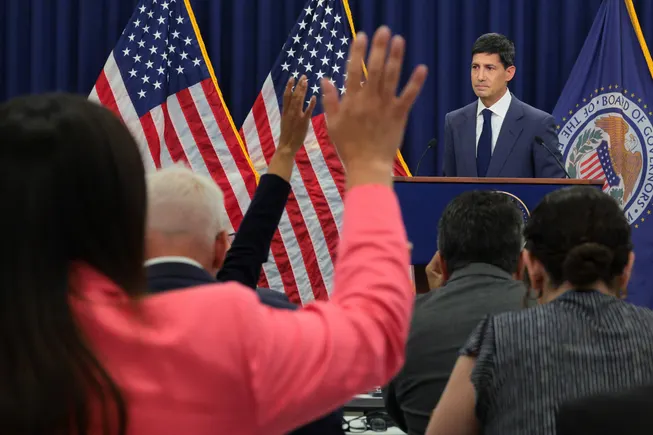
- In response to questions at his second press conference as chair on Wednesday, Fed Chair Kevin Warsh said, "I asked for a healthy debate, and I certainly got one." He added, "In my view, that's a better path to setting the right policy; that's our North Star."
In-Depth Analysis:
Warsh has been chair for about eight weeks and four days—he joked on Wednesday that he wasn't keeping track—and he described the two-day meeting discussions as "cordial and constructive."
The Federal Open Market Committee's (FOMC) July decision was the second rate decision under Warsh's leadership. In June, he stated that the central bank was committed to easing pricing pressures. On Wednesday, Warsh also discussed the Fed's decision under his leadership to adopt a more opaque approach to monetary policy communication. He endorsed this approach, saying it would allow markets toreact more freely and directlyto economic data.
The FOMC's statement on Wednesday did not include projections or forward guidance. Warsh said that in the current uncertain environment, the central bank deemed this choice "particularly prudent." In response to questions, he said that through this decision, he hoped to see markets send "direct" or "unfiltered" signals in response to economic data.
"We're trying not to interfere with market signals... So markets will react more directly to events, and that's a good thing," he said.
Warsh also emphasized the Fed's commitment to achieving price stability. He said that despite the split vote, the two-day meeting discussions showed broad consensus among participants on the central bank's goals and purposes, though there were clearly some "leanings" on how best to achieve them.
"The path to the central bank's ideal state lies in fulfilling our duties," Warsh said. "Today, that means achieving price stability."
The FOMC said on Wednesday that despite economic uncertainty, economic activity continued to grow at a "solid pace," citing strong productivity growth and capital investment, while the unemployment rate remained largely stable.
However, inflation remains above the central bank's 2% target. The FOMC said in its statement that this is partly due to "supply shocks in certain industries, including energy, which have pushed up prices."
Partly due to the war with Iran, energy prices have remained volatile. According to Trading Economics data, Brent crude oil prices surged over 6% on Wednesday, breaking above $89 per barrel,ending a three-day losing streak, as supply concerns from the conflict resurfaced.
As previously reported by CFO Dive, Warsh promised in June that after consumer prices rose less than expected last month, the central bank wouldcontinue to workto ease inflation. According to the U.S. Bureau of Labor Statistics, consumer prices rose 3.5% year-over-year in June, down from 4.2% in May.
On Wednesday, the Fed chair was asked about the decision to hold the main interest rate steady in July amid ongoing pricing pressures—a decision that had previously sparked market expectations of a rate hike. According to Axios, in comments before the Fed's June meeting, both Logan and Hammack hadwarned of the possibility of a rate hike。
In response to questions, Warsh said the Fed's July decision was the "beginning" of the story, not the end, characterizing the decision to hold the main rate steady as a "rigorous examination of the economic situation."
Warsh also answered questions about the five working groups the central bank established shortly after his tenure began.These working groups are focused on studyingareas including balance sheet policy decisions, how the Fed handles communication of monetary policy decisions, and a group evaluating the impact of artificial intelligence.
Warsh said he would review progress with each working group between Wednesday's decision and theJackson Hole Economic Symposium(scheduled for August 27-29).