
Amazon Activates Mass Timber Delivery Facility, Creating a Sustainable Construction Laboratory
Amazon announced on Thursday the opening of a delivery facility in Elkhart, Indiana, whose structure extensively uses mass timber (a low-carbon building material) and integrates more than 40 sustainability initiatives. The company stated that the facility will serve as a 'laboratory' for sustainable construction and operations to test and promote related practices.
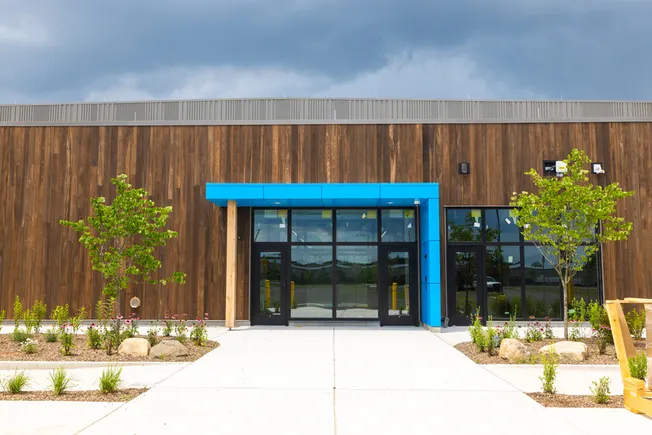
News Summary
- Amazon announced on Thursday the opening of a delivery facility in Elkhart, Indiana, whose structure is largely made of mass timber, a low-carbon building material, and includes more than 40 sustainability initiatives, according to a company blog post.
- Although its function as a last-mile stop for packages remains unchanged for customers, the e-commerce and tech company said it plans to use the facility as a "laboratory" for sustainable building and operational practices. Initiatives include low-carbon asphalt and concrete, permeable pavement, and a water recycling system.
- Mass timber is a durable alternative to industrial building materials such as concrete and steel. A 2022 study in Building and Environment showed that mass timber buildings have an average embodied carbon footprint nearly 43% lower than reinforced concrete buildings. Other tech giants like Meta and Microsoft have also begun integrating cross-laminated timber into some data center structures.
In-Depth Analysis
Amazon has set a goal to achieve net-zero carbon emissions across its global operations by 2040, and noted in an August 9 blog post that buildings and construction account for 40% of global greenhouse gas emissions, a figure sourced from the Carbon Leadership Forum.
The e-commerce giant has previously used mass timber in other structures, including its HQ2 campus in Arlington, Virginia, but this is the first time at this scale, Amazon's Vice President of Global Real Estate, Daniel Mallory, told ESG Dive.
Mallory said in an interview last week that the facility's innovation lies in the combination of multiple initiatives, which the company hopes to learn from and share with the industry. The global real estate executive believes that engaging with the industry on sustainable measures is a "critical" responsibility for Amazon, consistent with the company's Climate Pledge.
"Doing projects like this allows us to continue to earn the license (to engage with the industry), not just because of the scale, but because we pay attention to detail and can help engage and inform based on that," he said.
Mallory said not all of the incorporated sustainable measures will ultimately prove most useful in Indiana, but they may help the company at other properties globally. For example, he cited the facility's water recycling system—which collects rainwater, filters it, and stores it for flushing toilet fixtures—is not an urgent issue in Indiana because the state has abundant and low-cost water, but it could be more useful in regions where local resources are constrained.
The project's general contractor was Graycor Construction, with architecture firm ZGF serving as design architect and sustainability lead. Other participating companies include low-carbon concrete manufacturer CarbonCure, mass timber company Sterling Structural, thermally modified wood supplier Arbor Wood, and wood fiber insulation company Timber HP.
While a range of other initiatives hold potential promise for other Amazon facilities, the use of mass timber helps provide a "proof of concept" to drive industry scaling and reduce price premiums, Mallory said. John Denbo, the project executive in charge of the project, told ESG Dive that some mass timber manufacturers and suppliers have invested in increasing capacity. As demand grows, he expects prices to become more competitive compared to traditional methods.
"As (mass timber) becomes more common, the price will come down," Denbo said in an interview on Wednesday. "Will it always stay at the same price? Probably not. But it's something people have to be willing to do. There's some responsibility here that people are taking on to ensure and decide that they want to lower their carbon footprint."
Denbo said Graycor has a 20-year relationship with Amazon and has previously built delivery facilities for the company, typically using concrete and with third-party development. In addition to incorporating mass timber and sustainable measures into the project, Amazon also developed the property itself, which Denbo said provided Graycor with the opportunity to work directly with them. He described the project as the result of a "partnership in a forward-looking project."