
Bally's Slows $1.7 Billion Casino Construction After Chicago Expands Gambling Rules
Bally's Chicago is slowing parts of its $1.7 billion development, involving a hotel, event center, and restaurants, after the city expanded gambling rules, affecting 1,500 workers, but the casino's opening timeline remains unchanged.
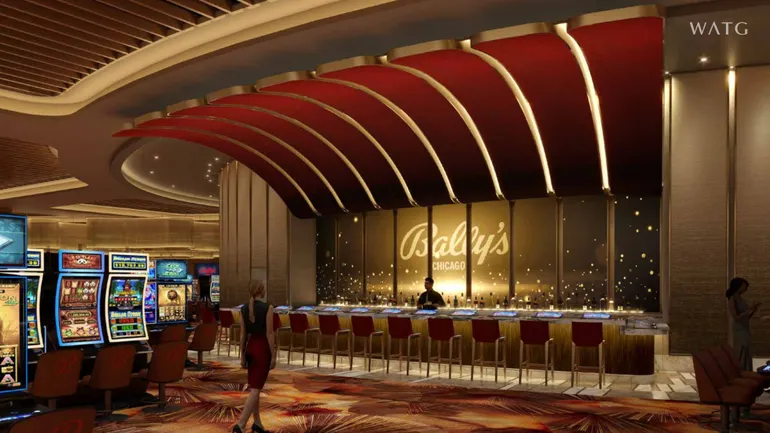
At a Glance
- The owner of a $1.7 billion casino development in Chicago has slowed construction on the complex due to a dispute with the city over the legalization of video gambling terminals, according to the Chicago Tribune.
- Casino owner Bally's Chicago has informed construction team Chicago Community Builders Collective (CCBC) that it is "recalibrating the pace of construction," Bally's said in a statement provided to Construction Dive.
- At the heart of the dispute is Chicago's recent approval of video gambling terminals, which Bally's claims violates its 2022 Host Community Agreement with the city. The city approved the terminals last fall and included the revenue in its 2026 budget, according to the Tribune.
Deep Dive
Affected construction activities include the hotel, event center, and restaurants, according to the Tribune. Due to the scaled-back scope, 1,500 union construction workers are impacted, per Bally's statement.
Bally's first received approval in 2025 to redevelop a 30-acre site along the Chicago River, formerly the site of the Tribune's printing plant.
Additionally, CCBC — a joint venture of Gilbane Building and several Chicago-area companies — topped out the casino's main structure in April, which is the core of Bally's project.
Bally's said it still plans to maintain the original timeline for casino construction and fulfill its agreement with the city. But other non-gaming facilities, including the hotel tower, multiple restaurants, and the event center, are now on hold, according to the Tribune.
"Please note that the initial opening of the permanent casino remains scheduled for early 2027, and Bally's Chicago intends to fully fulfill its commitments under the Host Community Agreement," the company said in its statement.
CCBC and the mayor's office did not respond to requests for comment. Gilbane Building referred questions to Bally's.
Despite uncertainty surrounding the larger development, other flagship projects in Chicago are moving forward, such as the $5.7 billion Red Line extension and the new Chicago Fire stadium (costing $750 million), which will be the home of the city's professional men's soccer team.