
Answering "What Happened?": How Contractors Use 360-Degree Reality Capture to Reduce Risk and Protect Margins
Facing rework, disputes, and closeout challenges, contractors are turning to 360-degree reality capture. Trimble ProjectSight 360 Capture integrates AI-driven reality records directly into the project management platform, automatically geolocating site photos and videos to drawings and creating a searchable timeline, thereby reducing risk, accelerating dispute resolution, and optimizing profits.
On a Friday evening, a major rework claim dispute document lands on your desk. The irrefutable evidence that could protect your profit margin is hidden behind drywall that was sealed weeks ago. Meanwhile, your team is sifting through hundreds of documents, emails, and text messages, along with thousands of isolated site photos, hoping the evidence actually exists... and that they can find it.
What happened? When did it happen? Who is responsible? In every construction project, contractors face these questions.
Problems arise when on-site documentation takes a back seat to keeping the project on schedule and moving forward. When records are incomplete, hard to find, or never captured in the first place, teams absorb the costs through rework, disputes, delays, and closeout headaches.
Although the construction industry has been digitizing drawings, RFIs, schedules, and financial processes for years, the physical jobsite remains one of the weakest links in project intelligence. Yet, with shrinking margins, tightening labor constraints, and rising project complexity, contractors can no longer afford gaps in their project documentation.
Smarter documentation, simpler workflows
Photos and videos provide a clear record of progress on the physical jobsite, which is why many contractors are turning to 360-degree reality capture. However, not all capture software is the same. Using a standalonethird-party appbrings a host of headaches: managing multiple passwords, learning new app interfaces, and dealing with data silos that lead to inefficiency and frustration. When construction teams are racing against the clock, wrestling with disconnected platforms turns high-tech tools into schedule killers.
Contractors can bypass these hassles with 360-degree reality capture embedded directly into their project management platform. This is a new development, currently available only through Trimble ProjectSight 360 Capture. Trimble has proven that integrating AI-driven site visualization into a single hub can solve many thorny construction management problems by making documentation a natural byproduct of daily work. Site walkthroughs are thus transformed into a visual timeline.
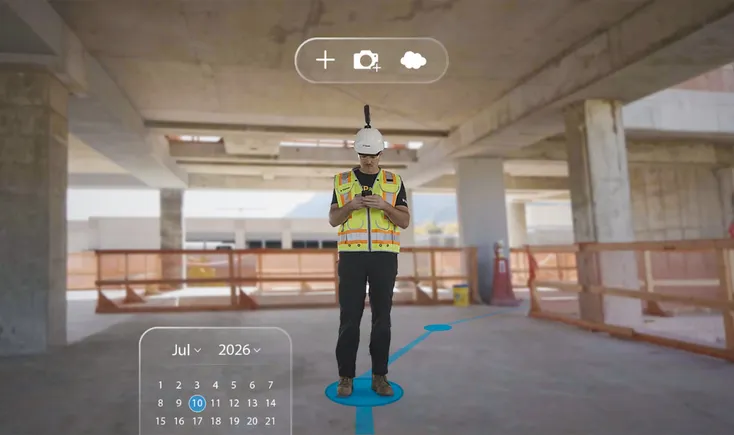
Workers simply mount a camera on their hard hat, press record, and walk the site. AI computer vision automatically tracks the path and pins each timestamped photo or video to the precise location on the construction drawings. This one-click operation allows contractors to delegate the task to field workers or even interns.
As a result, teams gain a searchable record system, accessible by location, date, or project phase, and built into the project management software they use every day. This comprehensive visibility enables contractors and project managers to:
- Verify site progress from the office.
- Resolve disputes with easily retrievable, real video or photo evidence.
- Prevent costly rework by catching mistakes early.
- Achieve seamless handover with a complete visual record.
- Validate subcontractor payment applications based on percentage complete.
From defensive documentation to operational advantage
Shifting documentation from a reactive activity to a strategic asset streamlines workflows for all stakeholders. Embedding 360-degree reality capture into a unified database is a key piece of building a complete site-to-office bridge.
With a single source of truth, data becomes actionable. BIM models, 3D renderings, and records are stored on the same platform as physical site photos and videos. RFIs, issues, or 3D models can be linked to timestamped images and compared side by side.
Specialty contractors can verify installations before other trades enter an area, inspect conditions hidden behind finished walls, and support as-built documentation and project closeout with less effort.
General contractors can go back to any point on the project timeline, remotely review site conditions across multiple jobsites, and provide owners and stakeholders with full visibility into project progress without requiring additional site visits.
Project executives can eliminate end-of-project bottlenecks, streamline closeout, and quickly redeploy resources to the next project.
A reality check for project leaders
When evaluating your current site documentation strategy, ask three questions:
- How long does it take to resolve documentation-related disputes?
- How much time is spent managing site photos and videos?
- How much profit margin is at risk due to construction disputes?
If these questions reveal operational friction, it may be time to rethink how your organization captures site data—not by collecting more photos or managing another app, but by enabling seamless communication between the field and the office through a unified database.
Ultimately, contractors who can quickly answer "What happened?" will spend less time defending their work and more time building.
About ProjectSight 360 Capture
ProjectSight 360 Capture helps contractors create a timestamped visual history of the site, making it easier to verify progress, resolve disputes, and streamline closeout.
Learn more about ProjectSight 360 CaptureHow it helps teams answer one of the most important questions in construction: What happened?