
The Construction Robot Revolution: Technology Leads, Industry Follows Slowly
The construction industry has been slow to adopt robotics, with only 55% of companies using robots, far behind automotive (84%) and manufacturing (79%). Experts believe that robots will become widespread on U.S. construction sites within the next 5 to 20 years, but costs, industry inertia, and labor impacts remain major obstacles.
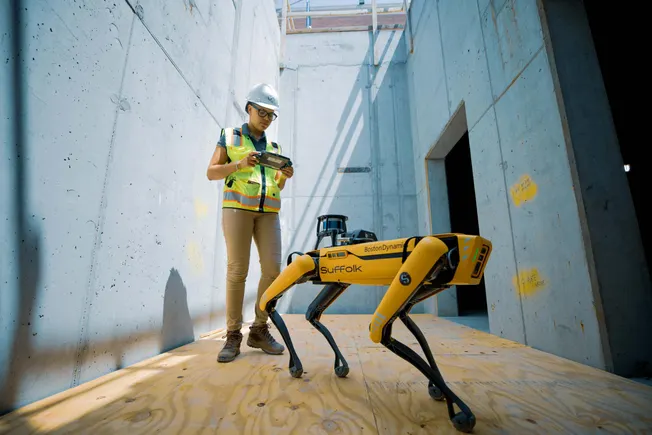
In the field of construction technology, contractors' adoption of advanced technology lags far behind the rapid development of the technology itself. Take pre-marked construction sites as an example: in the past, surveyors and skilled workers needed to be on-site to record overall elevations, the volume of earth to be brought in or removed, and building layouts. Today, drones can capture this data, and robots can complete the layout work, saving time, energy, and money.

However, according to a survey commissioned by ABB Robotics, a subsidiary of global technology company ABB, only 55% of construction companies in the United States, Europe, and China reported using robots, compared to 84% of automotive companies and 79% of manufacturing companies. Despite the slow adoption rate, the construction industry is on the brink of a robotics revolution.
"I think things are really starting to accelerate in construction robotics," said Venkat Krovi, a professor of vehicle automation at Clemson University in South Carolina. "I'm very pleased to see the industry's interest." Experts point out that robot-driven construction sites are not a distant fantasy; relying on technology-driven machines to handle most of the heavy, dirty, and dangerous work on sites does not require decades of research and advancement. In fact, many predict that robots will become common on U.S. construction sites within the next 20 years, and some believe it could happen in as little as five.
What is a robot
Chen Feng, an assistant professor at the NYU Tandon School of Engineering, said a robot is technology that performs two functions: sensing the environment and acquiring information, then using that information to make decisions. Feng noted that most robots currently used on construction sites include task inspection aids (such as drones), autonomous excavators, or exoskeletons that reduce the burden on humans carrying heavy objects or materials. But fully autonomous robots—what Feng jokingly calls the "Terminator stage"—are not yet close to becoming a reality. "There are many things we think robots can do that they can't yet," Feng said.
A worthwhile trade-off?
For industry-wide adoption, prices could exclude smaller-budget companies, a point even robot manufacturers acknowledge. For example, Brian Ringley, construction technology manager at robotics company Boston Dynamics, said any change to construction processes brings "a certain cost and disruption," and smaller contractors will wait for larger companies to lead the way. Boston Dynamics developed "Spot," a customizable quadruped robot designed specifically to capture data by walking around construction sites. It doesn't bark or bite, but it can take photos of the site, freeing up workers.
"For some of the new mobile robots moving around sites, they will wait until some of the larger companies with bigger projects, higher margins, and stronger R&D teams actually refine and operate these technologies before mass adoption occurs," Ringley said. Suffolk, a Boston-based contractor, uses Spot on its Massachusetts sites. The two-foot-tall robot, equipped with 360-degree cameras, walks around the site taking photos, eliminating the need for a human to do this task. Boston Dynamics told Construction Dive that the base model of Spot starts at around $100,000.

"You can imagine Spot taking on this work, giving project and commuter teams more time with higher-level site supervisors and project managers, thus spending more time solving problems rather than collecting data," said Kelsey Gauger, Suffolk's director of operational excellence. Adoption hesitation also stems from the construction industry's notorious resistance to change. In December, a report from Dodge Construction Network detailed the obstacles contractors often encounter when implementing digital strategies, from hardware issues to a lack of transformation roadmaps.
Assets on the modern site
Feng believes robots can provide workers with greater safety. Robots can help workers lift heavy objects through exoskeletons, or lift them themselves, thereby assisting or completely eliminating the physical strain on the body. Canvas, a San Francisco-based robotics company, has developed a robot to handle the arduous task of drywall plastering and sanding. Hanging drywall is overall an extremely strenuous job that can lead to back, arm, and shoulder injuries. Canvas's robot eliminates the need for humans to perform this part of the construction process.
Salt Lake City-based Sarcos Robotics has developed the Guardian XT unit, a robotic arm that can be remotely controlled by an operator to perform dangerous tasks. According to an investor report, contractors can rent the unit for $5,000 per month. A demonstration (see link below) shows the robotic arm trimming large tree branches under human remote operation.
Large contractors say they benefit from leading the adoption. Henning Roedel, robotics lead at DPR, a contractor based in Redwood City, California, said the company has also leveraged the productivity gains from robots. DPR uses Dusty Robotics' layout robot, and Roedel said productivity has seen a huge boost, with layout work six times faster than without the robot. Roedel said if a product contributes to safety, it attracts DPR's attention, but productivity will drive the bottom line and expand the company's usage.

San Francisco-based Swinerton has been making full use of this technology. Aaron Anderson, Swinerton's director of innovation, said the company has used Dusty's layout robot and Canvas's drywall robot. Anderson said both address common problems in the industry. "We are very actively looking for ways to increase productivity to address many labor shortages, improve quality, and more. Robotics is becoming one way to achieve that," Anderson said.
Job losses?
As robots take on more roles in construction, industry observers are watching whether they will replace workers on sites, and some labor activists say this could lead to lower wages and fewer job opportunities. A 2020 study by professors at MIT and Boston University found that in the United States, each additional robot per 1,000 workers reduced wages by 0.42% and the employment-to-population ratio by 0.2%. The study claims this has led to the loss of 400,000 jobs to date.
But at least one union leader is ready to welcome robot partners on construction sites. "We embrace the evolution of the construction industry; we don't fight it," said Jay Bradshaw, executive officer of the NorCal Carpenters Union. "The reason is simple—we not only want to be prepared for it, but also want to be part of it." Bradshaw represents 38,000 skilled workers across 22 unions in Northern California. "Throughout history, it's not hard to find examples of attempts to stop technological evolution in any industry, and those organizations never fared well," Bradshaw said. Bradshaw said robot training is already underway in the union's Northern California carpenter training programs, such as the Carpenters International Training Center in Las Vegas. Training continues for apprentices and journeymen, but Bradshaw acknowledged it hasn't been fully rolled out.
However, some scholars are skeptical about whether employment and the future of robots can be predicted. "I think the (labor) situation is complex, and no one can be certain," said Juan De la Fuente, a visiting assistant professor at Widener University in Chester, Pennsylvania. He pointed to countries like Germany and Japan, where robots and people work side by side in their economies. According to the International Federation of Robotics, these two countries rank third and fourth, respectively, in the world's most automated countries. The United States ranks ninth on that list.
Where are we now?
Experts agree that the era of robotic advancement is drawing nearer, but timelines for when contractors will see mass adoption vary. Most experts believe robots will become widespread soon, while others hold more conservative estimates. "I think (5-10 years) is very optimistic," De la Fuente said. "It's not just about creating the technology, but getting everyone else to accept technology in the workplace." De la Fuente said he expects the industry's current slow progress with robots to accelerate soon, predicting widespread adoption within the next 20 years.
For Bradshaw and his workers, being present and part of a robot-assisted future is the ultimate goal. He referenced the invention of the automobile, noting that even when carriage makers were angry and wrote to Congress, it didn't change anything. "The car was coming anyway," Bradshaw said.
Correction: This article has been updated to clarify Canvas's robot capabilities.